
What Is Female Pattern Hair Loss?
Female pattern hair loss (FPHL) is the most common form of progressive hair thinning in women. It is a nonscarring condition, which means the follicles remain present even as they gradually produce finer, shorter hairs. FPHL can begin after puberty, but it becomes more common with age and is especially noticeable for many women during and after menopause.1,4
The earliest change is often subtle: a wider middle part, less volume on top, more scalp showing under bright light, or a smaller ponytail. The frontal hairline is usually preserved, although some women develop recession at the temples or a pattern that resembles male pattern hair loss.1,4
FPHL can affect confidence, identity, and quality of life. That emotional impact is real, and it deserves the same thoughtful attention as the medical diagnosis.1
How Common Is It?
Studies all show the same trend: female pattern hair loss becomes more common with age. It affects about 12% of women by age 29, 25% by age 49, 41% by age 69, and more than half by age 79.1,4
What Happens to the Hair Follicles?
Healthy scalp follicles normally produce thick, pigmented terminal hairs. In FPHL, susceptible follicles gradually become smaller. This process, called miniaturization, causes each new hair to grow thinner, shorter, and sometimes lighter in color. The growth phase of the hair cycle also becomes shorter, so the hair has less time to reach its previous length and diameter.1,2
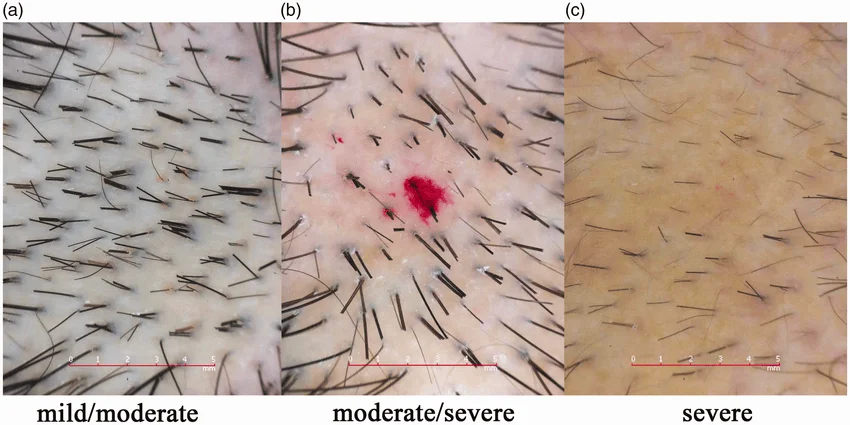
Trichoscopy shows variation in hair shaft diameters, more miniaturized/vellus hairs, peripilar halos, and reduced follicular density, which together confirm patterned hair thinning.
Miniaturization does not affect every hair equally. Thick and thin hairs become mixed together in the same area. A specialist can see these differences by examining the scalp under magnification.1
What Causes Female Pattern Hair Loss?
FPHL is best understood as a complex condition rather than the result of one hormone or one gene. Genetics, age, hormone signaling, and other biological factors can all influence when thinning begins and how quickly it progresses.1,2
Genetics
FPHL is polygenic, meaning that many genes may contribute to risk. These genes can come from either side of the family. A family history supports the diagnosis, but its absence does not rule it out. Relatives may also show different patterns, ages of onset, or degrees of thinning.2
Androgens and DHT
Androgens include hormones such as testosterone and dihydrotestosterone (DHT). They clearly drive most male pattern hair loss, but their role in women is more complicated. Some women with FPHL have increased androgen activity, yet most have androgen blood levels within the normal female range.1,6
In women who are genetically sensitive, androgens may gradually shrink the hair follicles. However, a blood DHT test cannot show what is happening inside the scalp follicles and is not usually helpful for diagnosing FPHL. Women can still have FPHL even when their androgen levels are normal.4,6
Age and Menopause
FPHL becomes more common after menopause because estrogen levels decline. Estrogen helps keep hair in its active growth phase, so lower levels may shorten the time each hair grows and allow more hairs to enter the resting and shedding phases. As estrogen decreases, the effects of androgens may also become more noticeable, even when testosterone levels do not increase.1,2
At the same time, normal aging causes hair follicles to produce finer hairs and reduces the number of actively growing hairs. Together, these changes can reveal or accelerate FPHL in women who are genetically susceptible. However, menopause is rarely the only cause, so other possible contributors should also be considered.
Common Patterns of Female Hair Thinning
Hair thinning does not look the same in every woman. Identifying the pattern helps measure its severity, track changes over time, and determine whether FPHL or another condition is causing the hair loss.1,5
Ludwig Pattern
The Ludwig pattern causes diffuse thinning over the top and crown of the scalp while the frontal hairline remains relatively intact. It is commonly described in three stages, from mild widening of the part to advanced loss of density over the crown.1
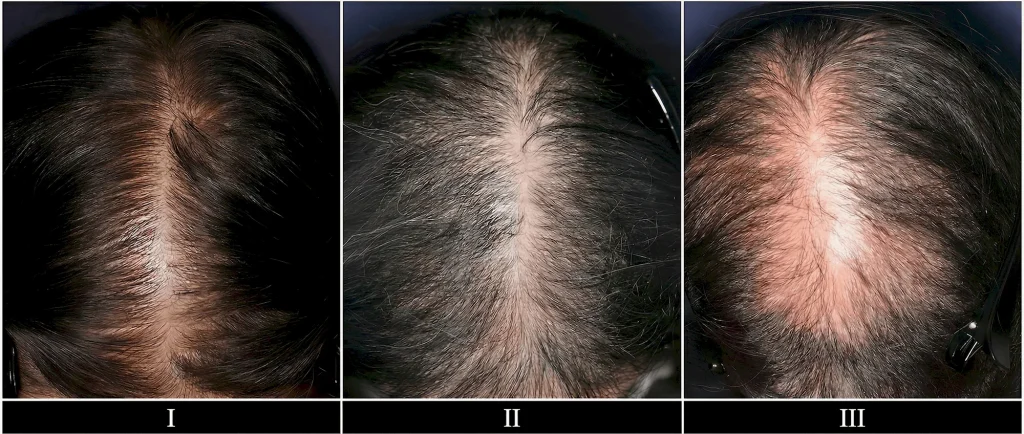
Sinclair Scale
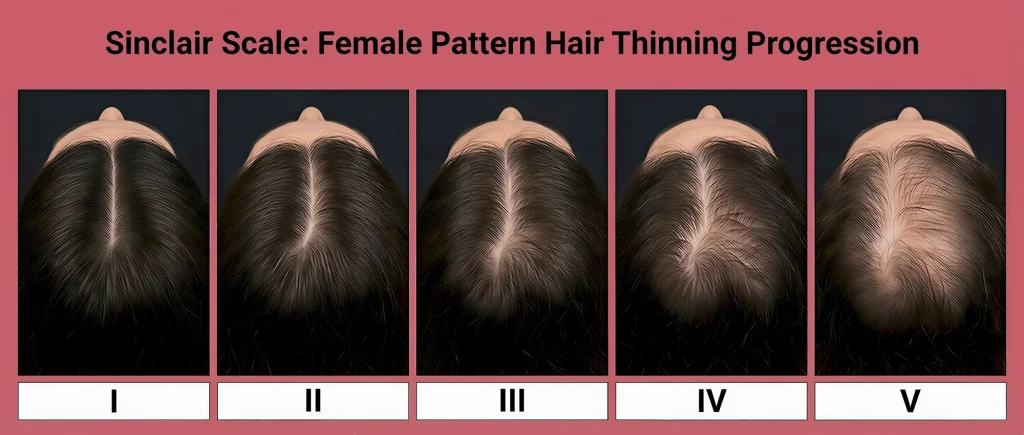
The Sinclair scale grades hair thinning from 1 to 5 based on how wide the middle part appears. Grade 1 represents normal hair density, while Grade 5 represents advanced thinning. It helps doctors track changes by comparing photographs taken over time.1
Olsen or “Christmas Tree” Pattern
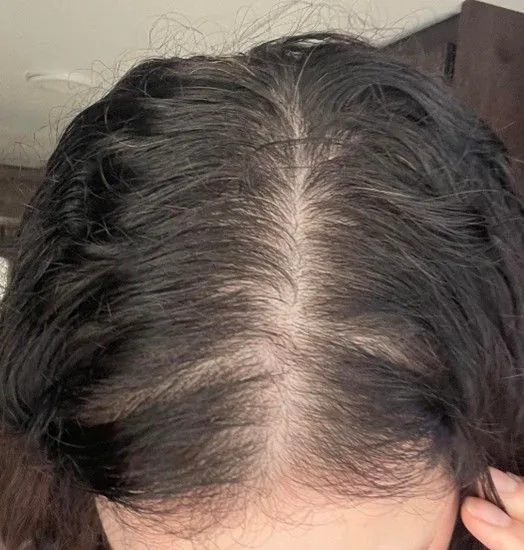
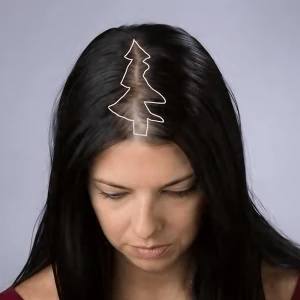
In the Olsen pattern, thinning is most noticeable toward the front of the central scalp and widens farther back, creating a triangular or “Christmas tree” shape. The frontal hairline may still be present even though density immediately behind it is reduced.1
Hamilton-Norwood Pattern
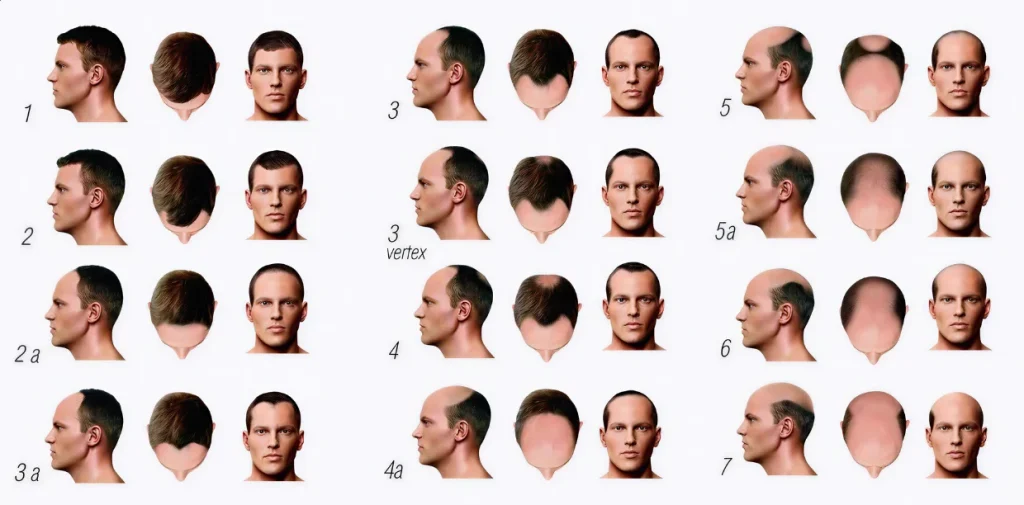
A smaller group of women develops recession at the temples, frontal hairline, or crown in a pattern that resembles male pattern hair loss. This pattern deserves careful assessment for signs of androgen excess, especially when it begins early or progresses rapidly.5,6
Why the Back and Sides of the Scalp Matter
The back and sides of the scalp are often denser than the top, but they should never be assumed to be permanently resistant to thinning. Some women have reduced density throughout the scalp, including the potential donor area used for hair transplantation.1
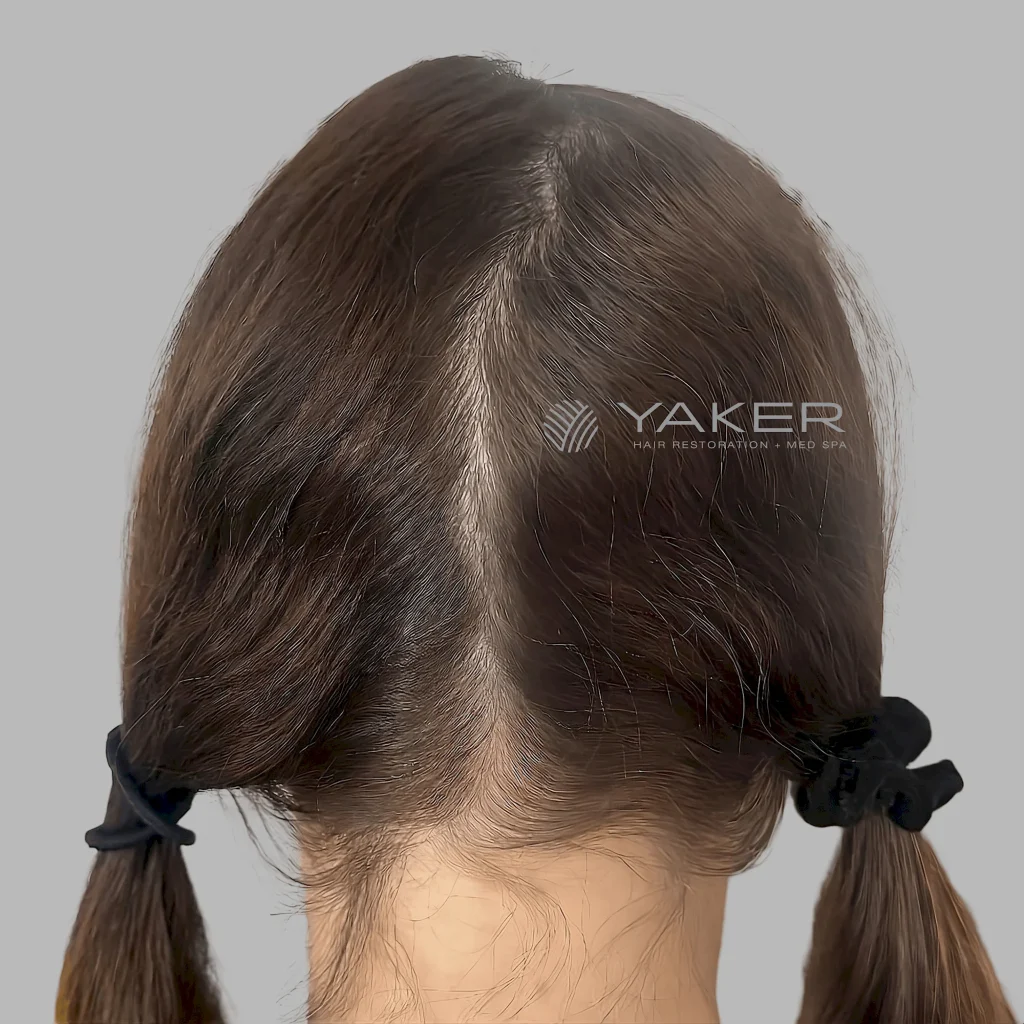
A careful examination of the entire scalp is important before surgery. Diffuse miniaturization in the donor area may limit the number of stable grafts and can make medical treatment a more appropriate first step. Thinning at the back does not automatically prove a nutritional, autoimmune, or hormonal disorder. It changes the differential diagnosis and requires closer evaluation.
How Female Pattern Hair Loss Is Diagnosed
FPHL is usually a clinical diagnosis. The evaluation combines the history, the visible pattern, the degree of shedding, and examination of the scalp and hair shafts. More than one condition can be present at the same time, so the goal is not simply to label the pattern but to identify everything contributing to it.4,6
A thorough evaluation may include:
- When the thinning started and whether it has been gradual, sudden, or episodic
- Where the thinning is most noticeable and whether shedding has increased
- Family history of hair loss on both sides of the family
- Pregnancy, menopause, illness, surgery, major stress, rapid weight loss, and dietary changes
- Menstrual regularity, fertility concerns, acne, and unwanted facial or body hair
- Medications, supplements, hormonal contraception, and hormone therapy
- Hair care practices, chemical processing, extensions, and tight hairstyles
- A full scalp examination and trichoscopy, with standardized photographs
A scalp biopsy is not routinely needed. It may be appropriate when the diagnosis remains unclear or when symptoms and examination raise concern for a scarring or inflammatory alopecia.4
When Blood Tests Are Helpful
Why Bloodwork Is Helpful
Bloodwork cannot diagnose female pattern hair loss, but it can uncover medical conditions that may cause additional shedding or make existing thinning worse. Identifying and treating these problems gives the hair the best opportunity to grow and respond to treatment.
Testing may look for:
- Iron deficiency or anemia, which can disrupt the hair growth cycle and increase shedding
- Active thyroid disease, which can cause diffuse thinning or excessive shedding
- Nutritional deficiencies, such as low vitamin B9, vitamin B12, vitamin D, and zinc, when the patient’s diet, symptoms, or medical history suggest a possible deficiency
- Hormonal conditions that may trigger or accelerate FPHL
Androgen testing is especially helpful when hair loss occurs with irregular periods, infertility, severe acne, male pattern hair growth, or even rapid progression. Testing may include total and free testosterone, sex hormone binding globulin, and DHEA-S to look for PCOS or another cause of androgen excess.
DHT blood testing is usually not helpful because the amount of DHT circulating in the blood does not show how much DHT is being produced within the scalp or how sensitive the hair follicles are to it. A woman can therefore have normal blood androgen levels and still develop FPHL.3,6
Conditions That Can Look Like or Overlap With FPHL
Increased shedding does not automatically mean FPHL is worsening. A patient may have patterned miniaturization, a separate shedding disorder, or both.
- Telogen effluvium: diffuse shedding that may follow illness, childbirth, surgery, severe stress, rapid weight loss, medication changes, or iron deficiency
- Diffuse alopecia areata: autoimmune hair loss that can sometimes resemble widespread thinning
- Traction alopecia: hair loss caused by repeated tension from tight hairstyles or extensions
- Scarring alopecia: inflammation that damages follicles and can cause permanent loss
- Hair shaft breakage: loss of visible length or density from heat, chemicals, friction, or structural weakness
Pain, burning, significant itching, redness, scales, pustules, loss of follicular openings, or sharply defined patches are not typical features of uncomplicated FPHL and should prompt closer evaluation.4
PCOS and Signs of Androgen Excess
Polycystic ovary syndrome (PCOS) can cause irregular ovulation, acne, unwanted facial or body hair, fertility concerns, and metabolic problems. Some women with PCOS also develop FPHL, but neither diagnosis automatically proves the other.6,7
PCOS evaluation is particularly important when patterned thinning occurs with irregular menstrual cycles, difficulty conceiving, hirsutism (growth of hair in areas where men typically grow hair, such as the face, chin, chest, abdomen, or back), or severe acne. Diagnosis should be made through an appropriate gynecologic or endocrine assessment, not from hair loss alone.6,7
Metabolic Health
Observational studies have reported an association between androgenetic alopecia and metabolic syndrome, a cluster that includes abdominal obesity, high blood pressure, abnormal cholesterol or triglycerides, and elevated blood sugar. A meta-analysis found higher odds of metabolic syndrome among people with androgenetic alopecia, but the included studies cannot prove that hair loss causes metabolic disease or that metabolic disease causes hair loss.8
Screening should follow the patient’s overall health risks rather than hair appearance alone. Blood pressure, weight history, family history, and routine preventive care remain the appropriate starting points.
Hormonal Contraception and Hair Loss
Certain hormonal contraceptives may trigger or worsen female pattern hair loss in women who are genetically sensitive. This risk may be greater with contraceptives containing more androgenic progestins.
Androgenic activity describes how strongly a hormone or medication acts like an androgen, such as testosterone. A progestin with greater androgenic activity can activate androgen receptors more strongly. In genetically sensitive hair follicles, this signaling may accelerate miniaturization, causing the follicles to produce thinner, shorter hairs.
Progesterone is a hormone naturally produced by the body. Progestins are medications designed to produce some of the same effects as progesterone, but they are not all identical. Some progestins have androgenic effects, while others have little androgenic activity or may even block androgen effects. This is why different hormonal contraceptives may affect the hair differently.
Hormonal birth control can also cause telogen effluvium, a temporary increase in shedding. Starting, stopping, or changing birth control can create a sudden hormonal shift that pushes more hairs than usual from the growth phase into the resting phase. The resulting shedding typically becomes noticeable two to three months later.
The two conditions can also occur together. Telogen effluvium may make previously subtle female pattern hair loss more noticeable by rapidly reducing overall density. Unlike telogen effluvium, which is often temporary, female pattern hair loss is progressive and usually requires ongoing treatment.
Not every woman will experience hair loss from hormonal contraception. The risk depends on the specific hormone formulation, the degree of androgenic activity, the timing of hormonal changes, and the individual woman’s genetic susceptibility.
Menopause, Hysterectomy, and Hair Changes
Hair may become finer, drier, frizzier, or less dense during the menopausal transition. The change reflects a combination of aging, shifting hormone balance, genetic susceptibility, and sometimes additional conditions such as thyroid disease, iron deficiency, or telogen effluvium.1,2
A hysterectomy removes the uterus, but it does not necessarily cause menopause. If the ovaries remain, they may continue producing hormones. Removing both ovaries causes surgical menopause and a more abrupt hormonal change. The details of the surgery therefore matter when evaluating the timing of hair loss.
Testosterone Therapy and Hair Loss
Testosterone therapy can increase acne, facial or body hair, and scalp hair loss in susceptible women, particularly when dosing produces levels above the normal premenopausal range.
An international consensus statement concluded that the only evidence-based indication for systemic testosterone therapy in women is hypoactive sexual desire disorder in appropriately evaluated postmenopausal women. It recommends dosing that keeps testosterone within the physiologic premenopausal range, avoiding excessively high-dose preparations, and monitoring testosterone with reliable laboratory testing.
| Age | Total T (ng/dL) | Free T |
|---|---|---|
| 19–49 | 15–70 | 0.02–0.50 ng/dL (0.2–5 pg/mL) |
| 50+ | 5–45 | 0.01–0.35 ng/dL (0.1–3.5 pg/mL) |
Women using testosterone should tell their prescriber about new scalp thinning, acne, unwanted hair growth, or other androgenic symptoms. Treatment decisions should consider the indication, dose, formulation, measured levels, symptoms, and the patient’s individual hair loss risk.
Treatment Options for Female Pattern Hair Loss
Treatment is most effective when it begins before miniaturization becomes advanced. The goals are to slow further thinning, increase the thickness and length of miniaturized hairs, and improve visible coverage. No treatment works for everyone, and meaningful change usually takes at least 6 to 12 months.1,4
Topical Minoxidil
Topical minoxidil is the best established first-line treatment and the only medication approved by the U.S. Food and Drug Administration specifically for FPHL.
Benefits are maintained only with continued use. If treatment is stopped, the hair gradually returns toward the course it would have followed without treatment.14
Low-Dose Oral Minoxidil
Low-dose oral minoxidil is increasingly prescribed off-label, especially when topical treatment is ineffective, irritating, or difficult to use. Randomized and observational studies suggest that it can improve density and hair thickness, but dosing and monitoring must be individualized.
Spironolactone
Spironolactone is an off-label antiandrogen commonly used to treat FPHL. Androgen receptors are proteins inside cells that receive signals from androgens such as testosterone and DHT. When these hormones attach to androgen receptors in genetically sensitive hair follicles, they may cause the follicles to produce thinner hairs. Spironolactone competes for these receptors, helping block androgen signals from reaching the follicles.
Finasteride and Dutasteride (5-Alpha Reductase Inhibitors)
Finasteride and dutasteride reduce the conversion of testosterone to DHT and are sometimes prescribed off-label for selected women, most often after menopause.
Low-Level Light Therapy
FDA-cleared low level light devices can modestly improve hair density in some patients with androgenetic alopecia. Device design and treatment schedules vary, and long-term adherence is necessary. Light therapy is generally used alongside treatments that address the specific cause of your hair loss, rather than as a replacement for them.13
Platelet Rich Plasma
Platelet rich plasma (PRP) is made by concentrating platelets from the patient’s own blood and injecting them into areas of thinning hair. Platelets release growth factors, natural proteins involved in healing and tissue repair. These growth factors may help support hair follicle cells, improve follicle activity, and encourage thicker hair growth.
A 2024 meta-analysis of randomized trials found improvements in hair density and thickness in women, but protocols differed substantially among studies. Results depend on patient selection, preparation method, injection schedule, and maintenance treatment.12
Nutrition and Supplements
Correcting a true nutritional deficiency can help restore normal hair growth. However, “hair supplements” will not treat FPHL unless they contain something your body actually needs. Iron, vitamin D, zinc, protein, and other nutrients should be evaluated based on your bloodwork, diet, and medical history. Taking more than you need can be harmful, and high doses of biotin can cause incorrect laboratory results.
Hair Transplant Surgery
Hair transplantation may be an option for carefully selected women whose loss is stable with medication and whose donor area has adequate density and limited miniaturization. Diffuse thinning, active shedding, inflammatory scalp disease, or weak donor hair may reduce candidacy. Medical treatment is often recommended before and after surgery to protect existing hair.1,4