
A Light-Based Treatment for Hair Growth
Low Level Laser Therapy (LLLT), also called photobiomodulation or red light therapy, is a noninvasive treatment that uses specific wavelengths of light to stimulate biological activity within the scalp and hair follicles.
Unlike surgical lasers, LLLT does not cut, burn, or significantly heat the skin. Instead, the light interacts with cells and may influence cellular energy production, inflammation, blood flow, and signaling involved in tissue repair and hair growth. 1
LLLT has been studied most extensively for androgenetic alopecia, also known as male and female pattern hair loss.
How Does Low Level Laser Therapy Work?
Hair follicles are living structures that require energy and cellular signaling to grow hair normally.
Red and near-infrared light can be absorbed by components within the mitochondria, which are responsible for producing much of the energy used by our cells.
In hair follicles, photobiomodulation may help:
- Support cellular energy production
- Promote activity within weakened but still living hair follicles
- Help prolong the anagen, or active growth, phase of the hair cycle
- Influence inflammation and oxidative stress around the follicle
- Support signaling involved in hair growth
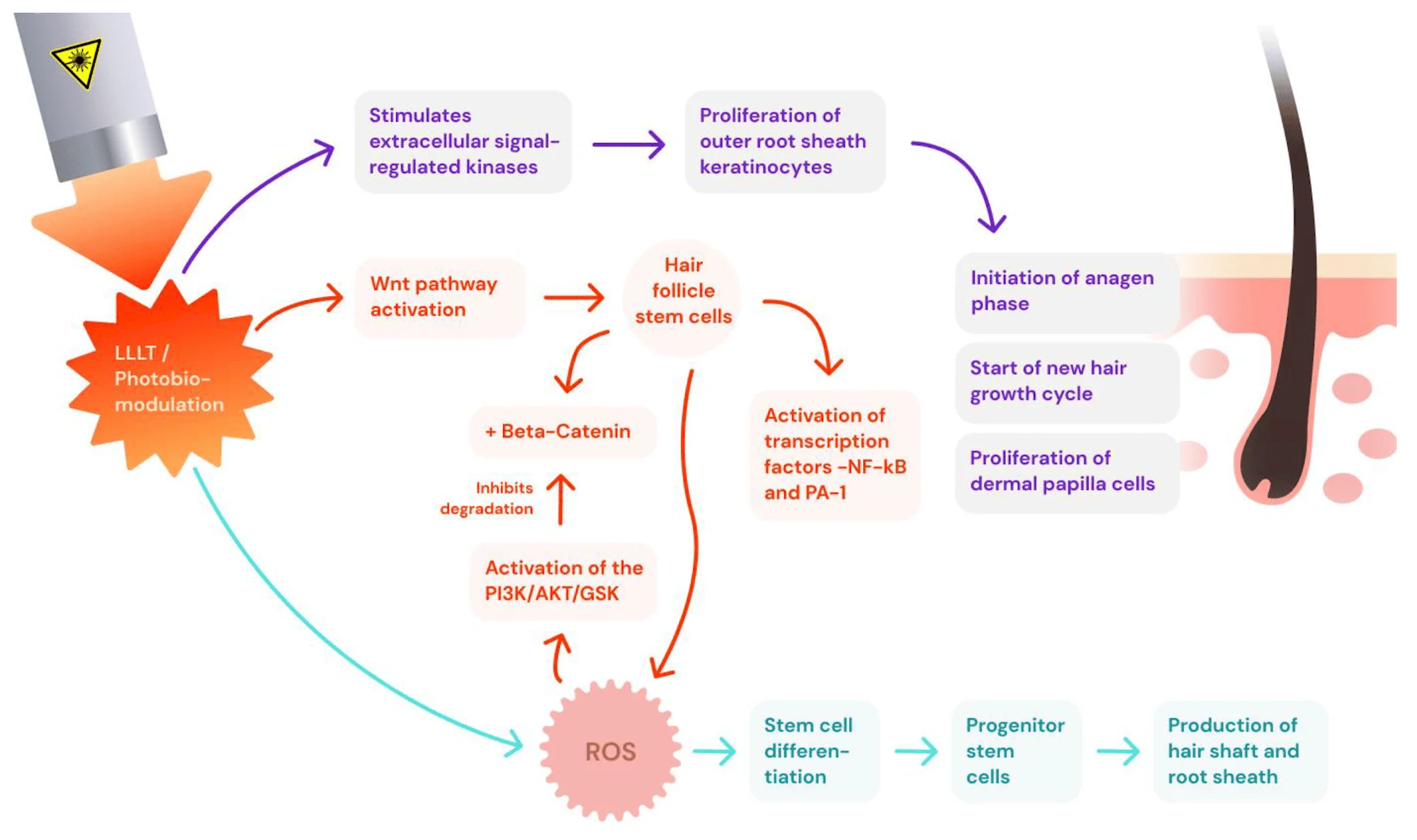
The exact mechanism responsible for hair regrowth is still being studied, and it is likely that several of these effects work together rather than one single mechanism being responsible.
What Type of Hair Loss Responds Best?
The strongest clinical evidence for LLLT is for androgenetic alopecia, or genetic pattern hair loss, including both male and female pattern hair loss.
LLLT works by stimulating existing hair follicles and cannot create new ones.
For this reason, treatment generally makes the most sense when thinning hair and miniaturized follicles are still present.
How Effective Is LLLT for Genetic Hair Loss?
Multiple randomized controlled trials and systematic reviews have found that LLLT can increase hair density in men and women with androgenetic alopecia.
A multicenter, randomized, double blind clinical trial involving 269 men and women found significantly greater increases in terminal hair density with laser treatment compared with sham devices after 26 weeks. 2
Another randomized controlled trial using a 655 nm device containing both lasers and LEDs found significantly greater hair count improvement in men receiving active treatment compared with placebo. 3
A similar randomized study in women also found significantly greater hair growth with active red light treatment compared with sham treatment. 4
A systematic review and meta-analysis of seven double blind randomized trials of FDA-cleared home devices also found a significant improvement in hair density compared with sham treatment in both men and women. 5
More recently, a systematic review and meta-analysis evaluated 38 studies involving 3,098 patients. Of these, 2,930 had androgenetic alopecia. The analysis found a significant improvement in hair density with low level laser or LED therapy compared with placebo, further supporting photobiomodulation as a treatment option for genetic hair loss. 6
How Does LLLT Compare with Minoxidil and DHT Lowering Treatments?
LLLT, minoxidil, finasteride, and dutasteride work differently.
LLLT can stimulate existing hair follicles and improve hair density, but it does not lower dihydrotestosterone, or DHT, which is one of the primary drivers of androgenetic alopecia in genetically susceptible hair follicles.
Finasteride and dutasteride directly reduce DHT and therefore target an important underlying cause of progressive hair miniaturization. Minoxidil stimulates hair growth through a different mechanism.
For this reason, LLLT should be viewed as an additional evidence-based treatment option rather than a replacement for treatments that address the underlying mechanisms of genetic hair loss.
It can be especially useful for patients who want to add another treatment mechanism to their existing hair loss plan.
Can LLLT Be Combined with Other Hair Loss Treatments?
Because genetic hair loss develops through multiple biological pathways and LLLT works differently from medications such as minoxidil, finasteride, and dutasteride, it is commonly used as a complementary treatment within a more comprehensive hair loss plan rather than as a stand-alone therapy.
A 2025 systematic review and meta-analysis of seven randomized clinical trials found that combining LLLT with topical minoxidil produced a greater increase in hair density and hair diameter than topical minoxidil alone. 7
Can LLLT Help Other Types of Hair Loss?
Possibly, but the evidence is much less established than it is for androgenetic alopecia.
Alopecia Areata
Alopecia areata is an autoimmune condition that causes patchy or more extensive hair loss.
Several types of light and laser therapies have been studied for alopecia areata. However, these studies include different wavelengths and technologies, some of which are very different from the home LLLT devices used for androgenetic alopecia.
LLLT should therefore not be considered a replacement for established medical treatments for alopecia areata.
Telogen Effluvium
Telogen effluvium is increased shedding that may occur after illness, significant stress, nutritional problems, hormonal changes, medications, surgery, rapid weight loss, or other physiologic stressors.
LLLT is not considered a primary treatment for telogen effluvium, and clinical evidence supporting its use specifically for this condition remains limited. However, because LLLT may support hair follicle activity and the transition of follicles into the active growth (anagen) phase, it may have a supportive role during recovery and regrowth.
The most important treatment for telogen effluvium remains identifying and correcting the underlying trigger whenever possible.
Scarring Alopecia
Inflammatory scarring alopecias such as lichen planopilaris and frontal fibrosing alopecia can permanently destroy hair follicles.
Small studies have investigated photobiomodulation in these disorders, but there is currently insufficient evidence to consider LLLT an established treatment. 6
Controlling the underlying inflammatory disease is the priority because once hair follicles have been permanently scarred, LLLT cannot recreate them.
Chemotherapy Related Hair Loss
LLLT has been investigated for chemotherapy-related hair loss, but the clinical evidence remains limited.
Scalp cooling, commonly called cold caps, has much stronger evidence for reducing chemotherapy-related hair loss. Cooling constricts blood vessels in the scalp and lowers activity within the hair follicles, which reduces the amount and effect of chemotherapy reaching these rapidly dividing cells. 8,9
Cold caps do not completely prevent hair loss in every patient, and effectiveness varies with the chemotherapy regimen. 8
LLLT and Hair Transplant Surgery
Photobiomodulation has biological effects that may support tissue repair and reduce inflammation, which has led to interest in using LLLT around the time of hair transplant surgery. 1
Some hair transplant patients also continue LLLT after surgery because it can help support their existing, non-transplanted hair when androgenetic alopecia is present.
Want to Know if Laser Therapy Can Help You?
Schedule a consultation with Dr. Yaker to find out if Low-Level Laser Therapy (LLLT) is the right fit for your type of hair loss. He’ll take a close look at your scalp, listen to your concerns, and help you choose the best treatment plan for your goals.
Not All LLLT Devices Are the Same
One of the challenges with LLLT research is that devices can differ considerably.
Important variables include:
- Wavelength
- Number and arrangement of light sources
- Energy delivered to the scalp
- Treatment duration
- Treatment frequency
- Scalp coverage
- Whether the device maintains consistent positioning
- Patient compliance
Most clinical studies of androgenetic alopecia have used red light wavelengths in approximately the 630 to 660 nm range, although other wavelengths have also been investigated. 3,5
More light is not automatically better. Photobiomodulation appears to have a dose-response relationship, meaning that too little energy may not produce the desired effect while excessive dosing may not provide additional benefit.
For this reason, consider wavelength, energy dose, treatment time, and frequency together rather than focusing on a single specification.
Lasers vs. LEDs
Both laser diodes and LEDs can produce photobiomodulation, but they deliver light differently.
Laser light is more directional and coherent. Directional means the light travels in a more concentrated beam rather than spreading widely. Coherent means the light waves are more organized and travel together in a uniform pattern.
LED light spreads more broadly and is less concentrated.
This difference allows laser diodes to deliver light in a more focused and directional manner toward the scalp and hair follicles.
There is some evidence favoring laser-based devices over LEDs. A meta-analysis found that studies using laser diodes alone produced a greater improvement in hair density than studies using combined laser and LED devices, although both approaches significantly outperformed control treatment. 10
This does not prove that every laser device is better than every LED or combination device.
Wavelength, energy delivered to the scalp, treatment duration, coverage, and device design also influence treatment.
What Affects Your Results?
Your Diagnosis
LLLT has the strongest evidence for androgenetic alopecia. Different causes of hair loss require different treatment approaches.
How Much Hair You Still Have
LLLT stimulates existing hair follicles. Patients with mild thinning and miniaturized hairs have more follicles available to respond than someone with a completely bald area.
Device Quality and Coverage
The light needs to reach the treated areas consistently. Device design, scalp coverage, energy delivery, and treatment protocol can therefore influence results.
Consistency
LLLT requires regular treatment. Using the device sporadically or stopping treatment prematurely can reduce its effectiveness.
Other Causes of Hair Loss
Genetics may not be the only factor affecting a patient’s hair. Hormonal abnormalities, nutritional deficiencies, medications, inflammation, scalp disorders, illness, stress, and other medical conditions may also need to be addressed.
LaserCap® HD+
The LaserCap® HD+ is an FDA-cleared home-use device for male and female pattern hair loss.
It contains:
- 304 laser diodes
- 650 nm red laser light
- Full scalp coverage
- Pulsed light delivery
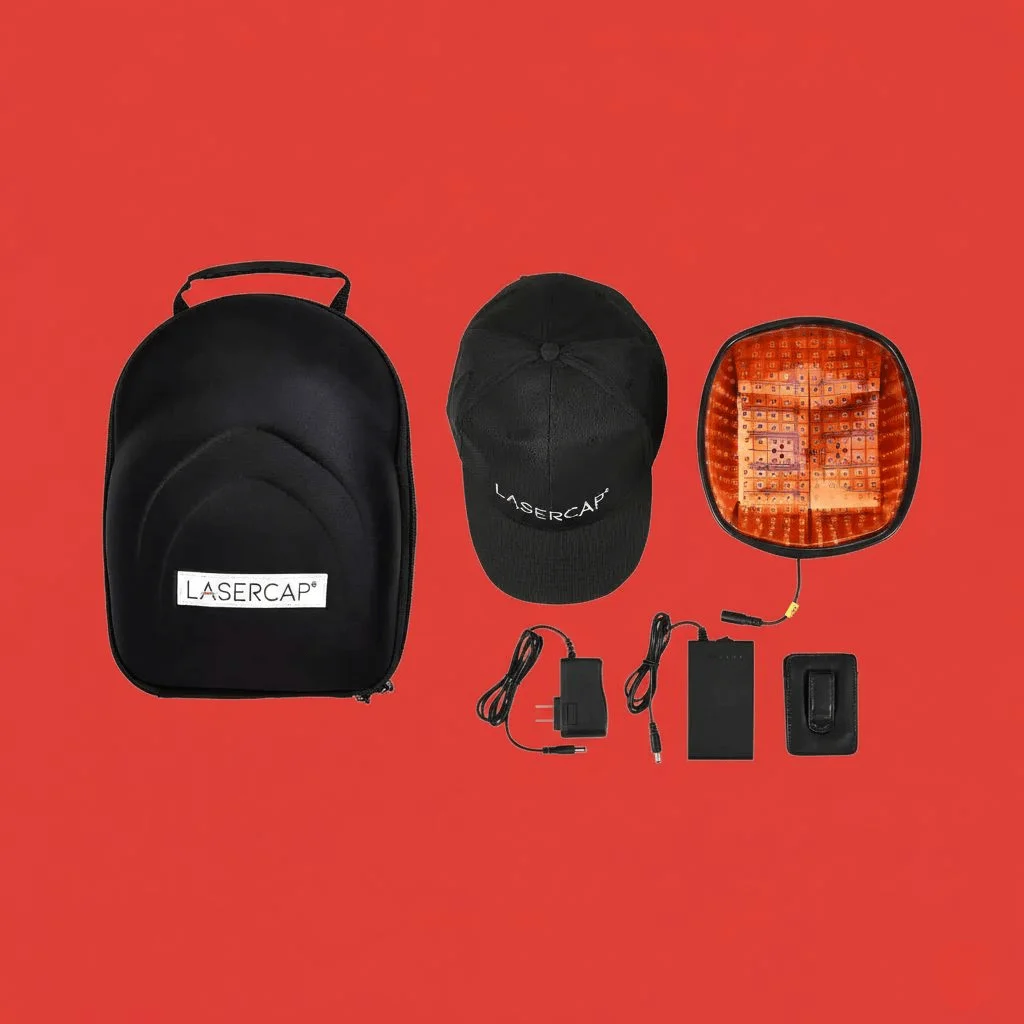
The LaserCap® HD+ delivers a reported energy dose of approximately 3.92 J/cm² during each treatment session. 11
In a 2025 optical comparison performed with calibrated optical equipment, the HD+ delivered the highest calculated energy dose among the devices tested: 11
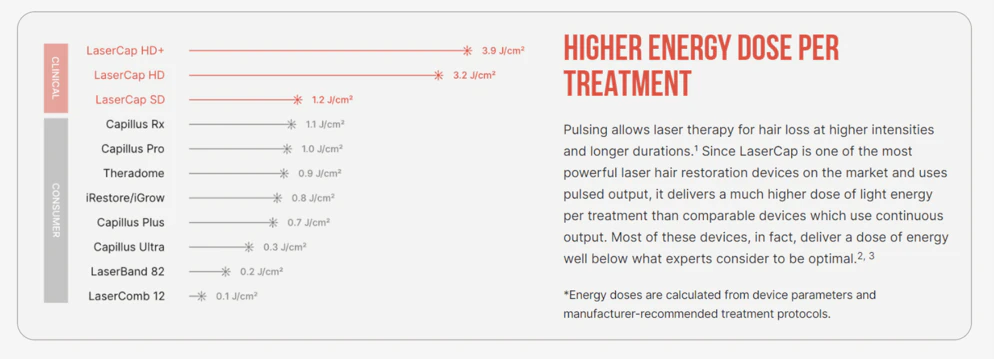
These numbers compare measured or calculated light energy delivered per treatment and should not be interpreted to mean that a device delivering four times the energy will produce four times the hair growth. There are currently no high quality head to head clinical trials demonstrating that difference.
Why Energy Dose Matters
Energy dose, or fluence, describes how much light energy is delivered to each square centimeter of the scalp during a treatment.
Research evaluating different LLLT protocols has found that energy fluence, treatment duration, and pulsed delivery can influence hair density. Simply increasing the number of laser or LED diodes was not independently associated with better hair growth. 12
This means that the number of lights inside a device does not tell the whole story. The wavelength, amount of energy reaching the scalp, treatment time, pulsing, coverage, and consistency of use all matter.
How to Use the LaserCap® HD+
The recommended treatment schedule is:
- 30 minutes per treatment
- Every other day
- Use consistently
Using the device more frequently or for longer periods should not automatically be assumed to produce better results.
When Should You Expect Results?
Hair grows slowly, regardless of the treatment being used.
Clinical LLLT studies commonly evaluate meaningful changes after approximately four to six months of consistent treatment. 2,5
Temporary Shedding Can Occur
Some patients experience increased shedding during approximately the first one to two months after beginning LLLT. 13,14
This is temporary and occurs as resting, or telogen, follicles are stimulated to transition back toward the active growth phase. Older resting hairs are released as the hair cycle changes.
Not everyone experiences this shedding, and its absence does not mean the treatment is not working.
Visible improvement usually takes several months because newly growing hairs need time to emerge from the scalp and become longer and thicker.
Do You Have to Keep Using LLLT?
Androgenetic alopecia is a progressive condition.
LLLT can stimulate susceptible hair follicles, but it does not eliminate the genetic tendency toward hair loss. Like other treatments for androgenetic alopecia, continued treatment is generally necessary to maintain the benefit.
If treatment is permanently discontinued, the additional support it was providing is gradually lost, and the underlying hair loss process can continue.
Are There Side Effects?
LLLT has generally been well tolerated in clinical studies.
Reported side effects are usually mild and may include:
- Temporary increased shedding
- Temporary scalp irritation
- Itching
- Dryness
- Mild headache
- Mild warmth or discomfort during treatment
Serious adverse events have been uncommon in published randomized trials and systematic reviews. 2,5,6
Is LLLT Right for Everyone?
No hair loss treatment works equally well for everyone.
LLLT tends to make the most sense when:
- Hair follicles are still present
- There is mild to moderate thinning rather than completely bald skin
- The diagnosis is androgenetic alopecia
- The patient is willing to use the device consistently
- Other important causes of hair loss have also been evaluated
The most important first step is determining why the hair is thinning. LLLT can be a useful part of a treatment plan, but it should not replace an accurate diagnosis.
Want to see real results?
Click here to view success stories from LaserCap® HD+ patients.
Ready to take the next step?
Schedule a consultation with Dr. Yaker to find out if the LaserCap® HD+ is right for your hair loss needs.