
Finasteride is one of the most extensively studied medications for male androgenetic alopecia (male pattern hair loss) and has been used for hair loss since the late 1990s.
How Was Finasteride Developed?
Finasteride was originally developed at a higher 5 mg dose to treat benign prostatic hyperplasia (an enlarged prostate). Researchers later found that lower doses could also help treat male pattern hair loss. In 1997, the FDA approved finasteride 1 mg daily, originally sold as Propecia®, specifically for male pattern hair loss.
How Does Finasteride Work?
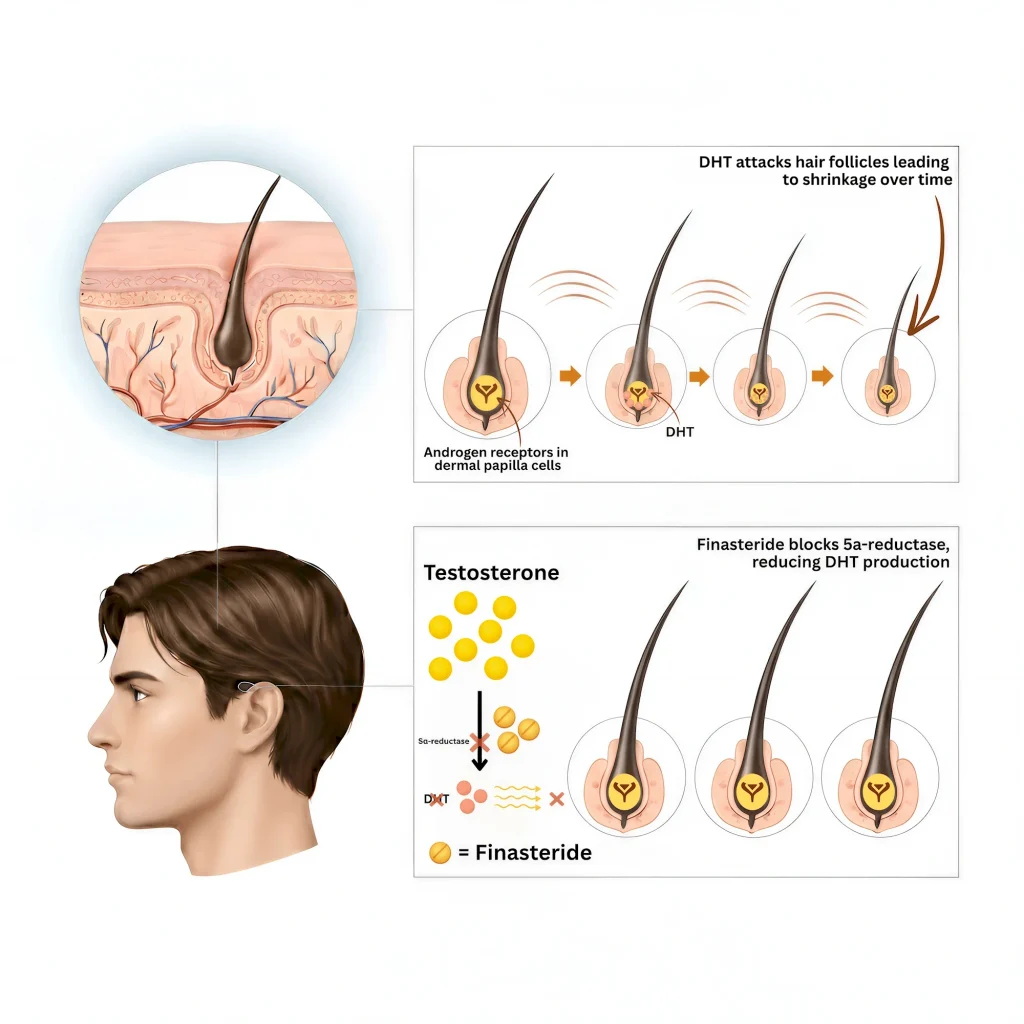
Your body naturally converts some testosterone into another hormone called dihydrotestosterone, or DHT.
In men who are genetically prone to male pattern hair loss, certain hair follicles are sensitive to DHT. Over time, DHT can cause these follicles to become smaller and produce hairs that are thinner, shorter, and less visible.
Finasteride helps slow this process by blocking type II 5-alpha-reductase, an enzyme the body uses to make DHT. By lowering DHT, finasteride helps protect genetically sensitive hair follicles from continued miniaturization.
Research in men has shown that oral finasteride 1 mg daily lowers DHT by approximately 64% in the scalp and 71% in the blood. A lower 0.2 mg dose also lowered DHT substantially, but clinical dose-ranging studies found that 1 mg provided the best overall balance for hair growth. Increasing the dose to 5 mg produced little additional DHT reduction and did not meaningfully improve hair-growth results.1,2
Finasteride does not completely eliminate DHT or permanently change your genetic tendency to lose hair. It helps control the process while treatment continues.
Finasteride does not lower testosterone. Because less testosterone is converted into DHT, testosterone may increase slightly after starting treatment but generally remains within the normal range. Studies suggest that this increase is most noticeable during the first several months and tends to move back toward baseline with continued treatment.
Why Does DHT Affect Some Hairs but Not Others?
Genetics determine which hair follicles are sensitive to DHT. This is why male pattern hair loss usually affects the hairline, front, middle, and crown, while hair along the sides and back of the scalp is typically much more resistant.
That is why two men can have similar DHT levels but experience very different amounts of hair loss because their follicles have different genetic sensitivities to DHT.
Oral Finasteride
Oral finasteride 1 mg once daily is the FDA-approved dose for male pattern hair loss in men. It has the longest clinical track record and the strongest long-term evidence of any finasteride formulation used for hair loss.
How Effective Is Oral Finasteride in Men?
One pivotal study included 1,553 men ages 18–41 with male pattern hair loss who received oral finasteride 1 mg daily or placebo for one year; 1,215 men continued into a blinded second year. Finasteride improved hair counts and patient, physician, and photographic assessments, while the placebo group continued to lose hair.3
Finasteride is not only about growing more hair. One of its most important benefits can be preserving hair that would otherwise continue to thin.
Does Finasteride Continue to Work Long Term?
A five-year clinical follow-up found that men who continued oral finasteride 1 mg maintained benefit, while men receiving placebo continued to lose hair. No new safety concerns emerged during the five-year study.4
A separate study followed 118 men taking oral finasteride 1 mg daily for up to 10 years. The benefit did not appear to wear off with time, and 21% of the men had additional improvement after more than five years of treatment.5
A large Japanese study evaluated men taking oral finasteride 1 mg daily. Among 2,561 men, 87.1% showed improvement: 11.1% significant, 36.5% moderate, and 39.5% slight. Adverse reactions were reported in 0.7% of the full 3,177-man safety population.6
A systematic review of 12 studies involving 3,927 men also found that oral finasteride improved hair outcomes compared with placebo.7
Does Finasteride Work Better at the Crown Than the Hairline?
Finasteride has been especially well studied at the crown and middle of the scalp, but it can also help frontal thinning. Results depend partly on how advanced the follicle miniaturization is.
In a five-year study of 126 Korean men taking oral finasteride 1 mg daily, 85.7% improved overall. Improvement was seen in 89.7% of crown hair loss cases, 61.2% of frontal-pattern cases, and 44.4% of cases dominated by hairline recession.8
This is why starting treatment earlier can matter. Thinning hair follicles that are still producing hair have a better chance of becoming stronger than an area that has been completely bald for many years.
Does a Higher Oral Dose Work Better?
Not necessarily. Dose-ranging studies in men compared oral finasteride 0.01, 0.2, 1, and 5 mg daily. The 1 mg and 5 mg doses produced similar hair-growth results, while 0.2 mg was effective but somewhat less consistent. This is why 1 mg daily became the standard hair-loss dose.2
More medication does not automatically mean more hair growth.
Topical Finasteride
Topical finasteride is applied directly to the scalp. It was developed to lower DHT around the hair follicles while reducing the amount of finasteride that reaches the bloodstream.
Topical does not mean there is no systemic absorption. Some finasteride can still enter the bloodstream and lower circulating DHT.
How Effective Is Topical Finasteride?
A Phase III randomized clinical trial included 458 men with androgenetic alopecia and compared topical finasteride spray with placebo, with oral finasteride also included for comparison. After 24 weeks, men using topical finasteride gained an average of about 20 hairs in the measured area compared with about 7 hairs with placebo. The improvement with topical finasteride was also similar to what was seen with oral finasteride.9
In the same study, maximum blood concentrations of finasteride were more than 100 times lower with topical treatment. Serum DHT fell 34.5% with topical finasteride compared with 55.6% with oral finasteride.9
A small, randomized study directly measured DHT in the scalp of men with androgenetic alopecia. After 7 days, topical finasteride 0.25% used once daily reduced scalp DHT by approximately 70%, compared with approximately 50% with oral finasteride 1 mg daily. This suggests that topical finasteride can strongly reduce DHT directly in the scalp.
Not all topical finasteride formulas work exactly the same. The strength, amount applied, ingredients in the formula, and condition of the scalp can affect how much finasteride reaches the hair follicles and how much enters the bloodstream.
Oral vs. Topical Finasteride: How Do They Compare?
Both can effectively treat male pattern hair loss, but there are important differences.
Oral Finasteride
- FDA-approved for male pattern hair loss in men
- Has the strongest and longest clinical track record
- Convenient once daily pill with consistent dosing
- Generally inexpensive
- Lowers DHT throughout the body more than topical finasteride
- Greater systemic exposure, which may increase the potential for systemic side effects
Topical Finasteride
- Applied directly to the scalp
- Can provide hair growth results similar to oral finasteride based on shorter-term studies
- Much less medication reaches the bloodstream
- Lowers bloodstream DHT less than oral finasteride
- Systemic side effects are still possible
- May cause scalp irritation, dryness, or buildup depending on the formula
- Used off-label for hair loss in the United States
- Formulas can vary in strength, ingredients, and absorption
Finasteride vs. Minoxidil
Finasteride and minoxidil both treat genetic pattern hair loss, but they work differently. Finasteride lowers DHT and helps protect genetically sensitive follicles from continued miniaturization.
Minoxidil works through different pathways to stimulate and support hair growth.
A randomized study of 65 men compared oral finasteride 1 mg daily with topical 5% minoxidil for one year. Improvement was reported in 80% of men taking oral finasteride compared with 52% using topical minoxidil.10
Why Can Combining Finasteride With Minoxidil Work Better?
Because the medications target different parts of the hair loss process, using them together can provide a more complete approach.
In a one-year study of 450 men, 80.5% improved on oral finasteride alone, 59% on topical minoxidil alone, and 94.1% on both treatments.11
A randomized 24-week study of 40 men compared topical 0.25% finasteride plus 3% minoxidil with 3% minoxidil alone. The combination produced significantly greater improvements in hair density and hair diameter, and about 90% of men using the combination had moderate-to-marked photographic improvement.12
Does Finasteride Cause Initial Hair Shedding?
Finasteride is not as commonly associated with an early treatment shed as minoxidil, but some patients may notice temporary changes in shedding after starting treatment.
No reliable clinical data show how many men shed after starting finasteride or how long it lasts. Early shedding also does not automatically mean the medication is making hair loss worse. The underlying hair loss may still be active while treatment begins to affect the follicles.
How Quickly Does Finasteride Work?
Finasteride starts lowering DHT soon after treatment begins, but hair grows slowly. Results should be judged in months, not weeks.
First 1–3 months: It is usually too early to judge the final response.
3–6 months: Some men begin to notice less shedding, greater stability, or early improvement.
6–12 months: Changes are easier to evaluate, especially with standardized before-and-after photographs.
12 months and beyond: Continued treatment can help maintain the hair being protected by finasteride, and some men continue to improve beyond the first year.4,5
What Happens if You Stop Finasteride?
A common myth is that stopping finasteride makes your hair loss worse than it would have been if you had never taken it. This is not actually the case.
Finasteride helps protect DHT-sensitive hair follicles, but it does not cure the underlying genetic tendency to lose hair. When treatment is stopped, DHT returns toward its untreated level and the protection gradually disappears. Over time, the hair that finasteride was helping preserve can begin to thin again.
If several years have passed while finasteride was maintaining your hair, it may look as though stopping the medication suddenly made your hair loss worse. In reality, you are losing the protection finasteride was providing while the underlying genetic condition resumes its natural course.
A helpful way to think about it is like medication used to manage another chronic condition. The treatment helps control the problem while you use it, but it does not permanently remove the underlying condition. This is why finasteride is considered a long-term treatment.
Finasteride Side Effects: Putting the Risk Into Perspective
Finasteride side effects, especially sexual side effects, receive considerable attention online. Patients deserve accurate information about these risks with the proper context.
Most men taking finasteride 1 mg for male pattern hair loss do not experience sexual side effects. At the same time, sexual adverse effects can occur and should not be dismissed when a patient experiences them.
What Sexual Side Effects Can Occur?
- Decreased sex drive
- Difficulty getting or maintaining an erection
- Changes in ejaculation
- Decreased amount of semen during ejaculation
A 2018 meta-analysis of 15 clinical trials involving 4,495 men found a relative risk of 1.66, meaning sexual side effects were somewhat more likely with finasteride than placebo, but remained uncommon overall.13
What Does the Newest Evidence Show?
A 2026 systematic review evaluated 41 studies of 5-alpha-reductase inhibitors in androgenetic alopecia. Across placebo-controlled trials of oral finasteride 1 mg in men, sexual adverse events were reported in approximately 1.9%–6.7% of men taking finasteride compared with 0.9%–3.9% taking placebo. Most events reported in the controlled studies were mild and reversible after stopping treatment.14
The same review found lower sexual adverse event rates with topical finasteride 0.25% than oral finasteride in the available comparative evidence, but longer-term topical data remain more limited.14
Sexual Side Effects Can Have Many Causes
If decreased libido or erectile dysfunction develops while taking finasteride, it is reasonable to consider the medication—but timing alone does not prove finasteride is the cause.
Erectile dysfunction (ED) means difficulty getting or maintaining an erection firm enough for sex. The American Urological Association estimates that up to 30 million men in the United States are affected.15
Other Common Causes of ED or Decreased Sexual Function
- Cardiovascular disease, high blood pressure, and high cholesterol
- Diabetes, insulin resistance, and obesity
- Low testosterone, thyroid disorders, or other hormonal changes
- Sleep apnea and poor sleep
- Depression, anxiety, stress, and relationship factors
- Smoking and excessive alcohol use
- Neurologic or prostate conditions
- Other medications, including certain antidepressants, blood pressure medications, diuretics, certain mental health disorder medications, sedatives, opioids, and some medications used for seizures or nerve pain
ED can also be an early sign of underlying cardiovascular or metabolic disease. This is why a new sexual symptom should not automatically be blamed on finasteride—or automatically dismissed as unrelated. The timing, sexual function before treatment, other medications, overall health, hormones, sleep, and psychological factors should all be considered.
Finasteride, Mood, Depression, and Suicidal Thoughts
Depression is common and can occur for many reasons unrelated to medication. In 2024, 8.2% of U.S. adults experienced a major depressive episode during the previous year.16
Depression and anxiety can be influenced by genetics, stress, health conditions, medications, hormones, and life circumstances. Hair loss itself can also affect emotional well-being.
Mood changes, depression, and suicidal thoughts have been reported in some people taking finasteride. However, determining whether finasteride is directly responsible can be difficult because these symptoms can have many causes.
A 2024 systematic review and meta-analysis involving more than 2.2 million people exposed to 5-alpha-reductase inhibitors found no statistically significant increase in depression or suicide overall.17
However, in 2025, the European Medicines Agency (EMA) confirmed suicidal thoughts as a possible side effect of oral finasteride 1 mg and 5 mg, although it could not determine how often this occurs. The review did not establish a link between suicidal thoughts and topical finasteride spray.18
These findings can both be true: large studies have not shown an increased risk overall, while rare mood-related side effects may still occur in some individuals.
If new or significant mood changes or suicidal thoughts develop while taking oral finasteride, contact your prescribing physician.
The Nocebo Effect and Finasteride
The nocebo effect occurs when expecting a side effect makes someone more likely to notice or experience that symptom. This does not mean the symptom is imaginary.
In a randomized study of 120 men taking oral finasteride 5 mg for an enlarged prostate, men who were specifically counseled about possible sexual side effects reported them more often than men who were not given that detailed warning. Among the 107 men who completed the study, one or more sexual side effects were reported by 43.6% of the counseled group compared with 15.3% of the group that was not counseled in the same way.19
This study used the stronger 5 mg prostate dose—not the 1 mg hair loss dose—so those percentages should not be applied directly to men taking finasteride for hair loss. It does show that expectations can influence reported sexual symptoms.
Can Sexual Side Effects Persist After Stopping Finasteride?
Most sexual side effects reported in clinical trials improve after stopping finasteride. However, persistent sexual symptoms after discontinuation have also been reported.
A 2011 study described 71 men with male pattern hair loss who reported sexual symptoms lasting at least three months after stopping oral finasteride. An important limitation is that the researchers specifically recruited men who were already experiencing persistent symptoms, so the study could not determine how often this occurs among all men who take finasteride.20
What Is Post-Finasteride Syndrome?
The term post-finasteride syndrome (PFS) is used to describe sexual, physical, or mood-related symptoms that some patients report continuing after they stop finasteride.
Whether these symptoms represent a distinct syndrome directly caused by finasteride is still being studied. We do not know exactly how often persistent symptoms occur, why some individuals may experience them, or who may be more susceptible.
This does not mean persistent symptoms should be dismissed, nor does it mean they are common. It means current research does not provide a reliable percentage risk or fully establish causality.
Does Finasteride Affect Male Fertility?
For most healthy men, oral finasteride 1 mg does not appear to significantly impair sperm production.
A randomized, double-blind study included 181 healthy men ages 19–41 who received oral finasteride 1 mg daily or placebo for 48 weeks followed by 60 weeks off treatment. Seventy-nine men participated in repeated semen testing. Finasteride did not significantly affect sperm concentration, total sperm count, motility, or morphology. Semen volume decreased 11% with finasteride and 8% with placebo, a difference that was not statistically significant.21
Men who already have fertility problems may respond differently. In a male infertility clinic population of approximately 4,400 men, only 27 were taking finasteride. After stopping it, sperm counts increased substantially in many of those men, suggesting that finasteride can reduce sperm counts in a susceptible subset.22
When finasteride does appear to affect sperm production, the effect appears to be reversible in many men within months after stopping treatment.
If you are concerned about fertility before starting finasteride, you can consider having a semen analysis beforehand. This baseline test can be compared with future testing if fertility concerns develop.
If you are having difficulty conceiving or have an abnormal semen analysis while taking finasteride, the medication should be considered as one possible—and potentially reversible—contributor.
Is There a Risk of Birth Defects if a Man Takes Finasteride?
Current evidence does not show that a man needs to stop finasteride simply because he and his partner are trying to conceive.
A small amount of finasteride can be present in semen, but pregnancy-safety guidance from MotherToBaby states that exposure through semen is not high enough to cause a problem for a developing fetus. Reports of pregnancies with paternal finasteride exposure have resulted in full-term infants without reported birth defects.23
This does not mean that every possible risk has been proven to be zero. If fertility is abnormal or conception is taking longer than expected, the medication can be reviewed as part of the fertility evaluation.
How Does Finasteride Affect PSA Blood Tests?
PSA (prostate-specific antigen) is a protein made by the prostate. A PSA blood test measures the amount of this protein in the blood and is commonly used to help screen for prostate cancer and monitor prostate health.
A randomized study included 355 men ages 40–60 with male pattern hair loss who received oral finasteride 1 mg daily or placebo for 48 weeks. Finasteride lowered the median PSA level by approximately 40% in men ages 40–49 and 50% in men ages 50–60.24
Always tell the physician reviewing your PSA that you take finasteride. This allows the PSA result to be interpreted correctly and helps prevent a finasteride-related decrease from making the PSA appear lower than it otherwise would be.
Does Finasteride Increase Prostate Cancer Risk?
The largest long-term study of finasteride and prostate cancer included 18,882 men and used oral finasteride 5 mg daily, which is five times the 1 mg dose used for hair loss. Men taking finasteride were diagnosed with fewer prostate cancers overall. The original study initially raised concern because more aggressive-looking cancers were detected in the finasteride group. However, later research suggested that finasteride’s effect on shrinking the prostate may have made these cancers easier to detect, and long-term follow-up did not show an increased risk of dying from prostate cancer.25
Can You Donate Blood While Taking Finasteride?
If you are taking finasteride, you should not donate blood for use by another person. The American Red Cross requires waiting 1 month after the last dose of finasteride before donating. For dutasteride, the waiting period is 6 months because it remains in the body much longer.26
If blood needs to be removed for medical reasons, such as therapeutic phlebotomy, this may still be possible through a facility that provides the service. When the blood is not eligible for transfusion, it can be removed for treatment and discarded. A physician’s order may be required, and policies vary by facility.
Does Finasteride Work for Female Pattern Hair Loss?
Finasteride is not FDA-approved for female pattern hair loss, but it is sometimes prescribed off-label to carefully selected women.
The 1 mg dose used for men did not work well in a randomized, placebo-controlled trial of 137 postmenopausal women with female pattern hair loss.27
Higher doses have shown more encouraging results. A study followed 112 premenopausal and postmenopausal women taking oral finasteride 2.5 mg daily for female pattern hair loss. Based on photographs, hair improved significantly in 65.2% of women, improved slightly in 29.5%, and showed no improvement in 5.4%.28
A 2021 meta-analysis combined nine studies involving 490 women with female pattern hair loss. Overall, 81% of women were reported to have some improvement, with better response rates in studies using finasteride doses of 2.5 mg or higher.29
A study of 40 postmenopausal women taking oral finasteride 5 mg daily for 18 months also reported improvement.30
Does Finasteride Increase Breast or Gynecologic Cancer Risk in Women?
A large population-based study identified 1,794,577 women with dermatologic conditions, including 13,853 women who had used finasteride or dutasteride. After matching users and nonusers for important health differences, 5-alpha-reductase-inhibitor use was not associated with an increased risk of breast or gynecologic cancers.31
A 2024 review specifically examining antiandrogen treatments for female pattern hair loss and gynecologic malignancies also found no evidence that finasteride increases breast-cancer risk in women.32
Women with a personal history of breast cancer, particularly hormone-sensitive disease, should discuss finasteride with their treating physicians before starting treatment.
What if a Woman Is Taking Finasteride?
Finasteride should not be taken during pregnancy because it lowers DHT, a hormone needed for the normal development of a male baby’s genitalia. This creates a theoretical risk of birth defects in a developing male fetus. However, this risk is based mainly on animal studies and how finasteride works; it has not been clearly demonstrated in human pregnancies.
Women who are pregnant or may become pregnant should not handle crushed or broken finasteride tablets. Intact tablets are coated, which prevents contact with the medication during normal handling. If you accidentally touch a crushed or broken tablet, wash your hands or the exposed area immediately with soap and water.23
Women who could become pregnant while taking finasteride for hair loss should use reliable contraception and discuss pregnancy plans with their prescribing physician.
Can Finasteride Be Used After Hair Transplant Surgery?
Finasteride can be especially helpful for men before and after a hair transplant.
A hair transplant moves hairs that are naturally more resistant to DHT into areas where hair has been lost, but surgery does not stop the patient’s existing, non-transplanted hair from continuing to thin.
Finasteride can help protect that existing hair. This can reduce the risk of ending up with strong transplanted hair surrounded by progressively thinner native hair and can help maintain a fuller, more natural-looking result over time.
Who May Be a Good Candidate for Finasteride?
- Adult men with male pattern hair loss
- Men in earlier stages of hair loss who still have miniaturized hair that can potentially be preserved or strengthened
- Men whose hair loss is progressing and who want to slow further loss
- Men who have had or are planning a hair transplant and want to protect their existing, non-transplanted hair
- Selected women with female pattern hair loss when pregnancy is not a possibility and off-label treatment has been carefully reviewed
Who Should Talk With Their Physician Before Taking Finasteride?
- Patients with significant baseline sexual dysfunction
- Men who are having difficulty conceiving or already have a low sperm count
- Patients with a history of significant depression, mood changes, or suicidal thoughts
- Men undergoing PSA monitoring or evaluation for prostate disease
- Patients with liver disease
- Women who are pregnant, planning pregnancy, or could become pregnant
Having one of these concerns does not automatically mean finasteride can never be used. It means the risks, alternatives, and monitoring deserve a more individualized discussion.
Where Finasteride Fits Into a Long-Term Hair Loss Plan
Finasteride is one of the most important treatments for DHT-sensitive genetic hair loss because it helps slow the ongoing miniaturization of susceptible follicles.
For some patients, success means visibly thicker hair. For others, it means keeping their hair stable and preventing further thinning. Sometimes the greatest benefit is something you cannot easily see: the hair you were able to keep because treatment slowed the progression of your hair loss.
Because genetic hair loss is chronic, your hair may go through periods when it looks better and periods when shedding or thinning seems more noticeable. That does not automatically mean finasteride has stopped working. Illness, nutrition, hormones, scalp inflammation, aging, medications, blood work imbalances, and other causes of shedding can overlap with genetic hair loss.
This is why we evaluate your hair over time using photographs and scalp examinations, along with blood work, nutrition, and an overall health review. The goal is to determine whether your hair is improving, remaining stable, or continuing to miniaturize—and whether anything else needs to be addressed.
For patients who benefit from finasteride, continued treatment is generally needed to maintain that benefit. Finasteride controls an ongoing genetic process; it does not permanently cure it.
Be Careful With Online Stories
Reading about other people’s experiences online can be helpful, but one person’s story cannot tell you how commonly an outcome occurs—or whether the same thing will happen to you. You also usually do not know that person’s complete medical history, other medications, hormone levels, underlying health conditions, or other factors that may have contributed to the symptoms.
Online discussions may also contain more negative experiences because people having a problem may be more motivated to post than people doing well.
One person’s experience does not mean you will have the same response. Treatment decisions are best based on good clinical evidence, your medical history, and how you personally respond to treatment.