
Typical Graft Ranges by Area
Every hair transplant case is different.
Your actual graft needs depend on the size of the area being restored, how much existing hair remains, the desired density in the area being restored, your donor density, number of hairs within each follicular unit, available donor supply, and your hair characteristics.
These numbers are general examples to show how hair graft needs can vary based on several factors. Your individual needs may be higher or lower and can only be determined through a personalized evaluation and surgical plan.
- Hairline only: Up to ~1,500 grafts
- Hairline and frontal scalp: ~1,500–3,000+ grafts
- Front and midscalp: ~2,500–4,500+ grafts
- Crown (vertex): A few hundred to several thousand grafts
How Many Hair Transplants Will I Need?
Some patients achieve their goals with one procedure, while others may need additional surgery for more coverage.
The number of procedures depends on how much hair you have lost, the size of the area being treated, your donor supply, desired density, and whether your native hair continues to thin.
This is why we plan beyond the first surgery. We want to use your donor hair in a way that still makes sense if your hair loss progresses years from now.
Hairline Design: Where Art Meets Strategy
The hairline is one of the most noticeable parts of a hair transplant because it frames your face. A natural-looking hairline should fit your age, ethnicity, facial features, and existing hair pattern, not simply be placed as low and straight across as possible. The goal is to create a hairline that looks natural for you today and stays appropriate as you age.
Why a Lower Hairline Is Not Always Better
A very low hairline may look appropriate when you are young but can look unnatural as you age. It also requires more grafts, which can unnecessarily use donor hair that may be needed later if your hair loss progresses.
In patients with more extensive or expected future hair loss, placing the hairline slightly higher may allow us to create better density while preserving hair grafts for other areas of the scalp.
Facial Proportions: The Rule of Thirds
One guide we can use when evaluating hairline placement is the rule of thirds, which divides the face into three general sections:
- Top third: hairline to eyebrows
- Middle third: eyebrows to the bottom of the nose
- Bottom third: bottom of the nose to the chin
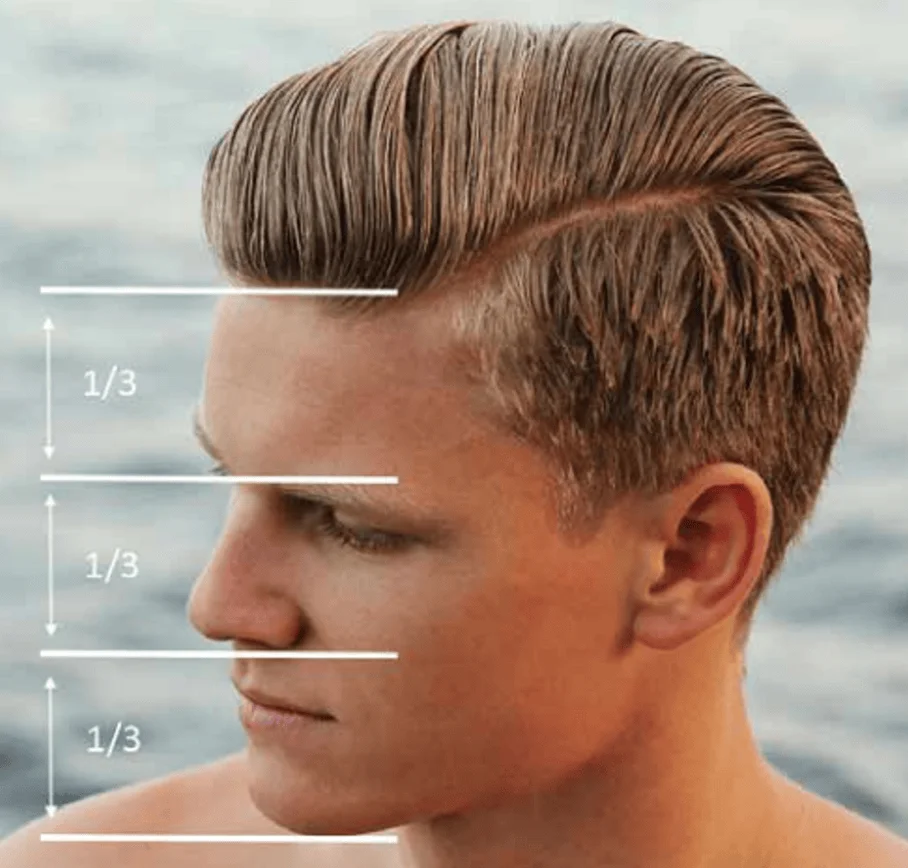
These proportions are a guide, not a formula. Your face shape, age, existing hairline, donor supply, amount of hair loss, and individual features ultimately determine where your hairline should be placed.
Creating a Natural Hairline
Natural hairlines are not perfectly straight or perfectly symmetrical. They contain subtle variations that make them look natural.
- Soft, single-hair follicular units are placed along the front edge
- Larger 2- to 4-hair follicular units are placed behind them to build density
- Subtle irregularities and small variations in spacing, direction, and angle help recreate the way hair naturally grows and prevent the hairline from looking too straight, uniform, or artificial
Side Profile Matters Too
A natural hairline needs to look right from the side as well as the front, and the design is different for men and women.
In men, the hairline typically follows the natural shape of the face, running relatively level or gradually receding as it transitions into the temples. The point where the frontal hairline meets the temple is called the frontotemporal angle. If a man’s hairline is placed too low or curves too far downward at the temples, it can look unnatural, overly feminine, or too youthful as he ages.
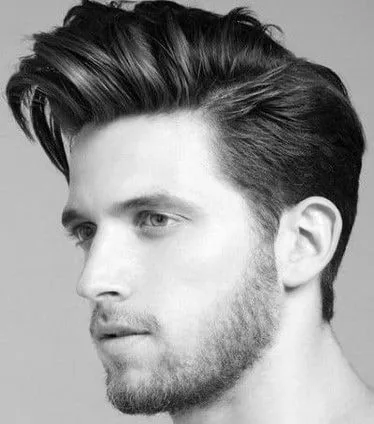
In women, the hairline is generally rounder and may curve slightly downward toward the temples, creating a softer frame around the face.
Crown Design: Recreating the Natural Whorl
The crown, also called the vertex, is the round or oval area toward the upper back of the scalp. Hair in this area naturally grows in a circular or spiral pattern called a whorl.
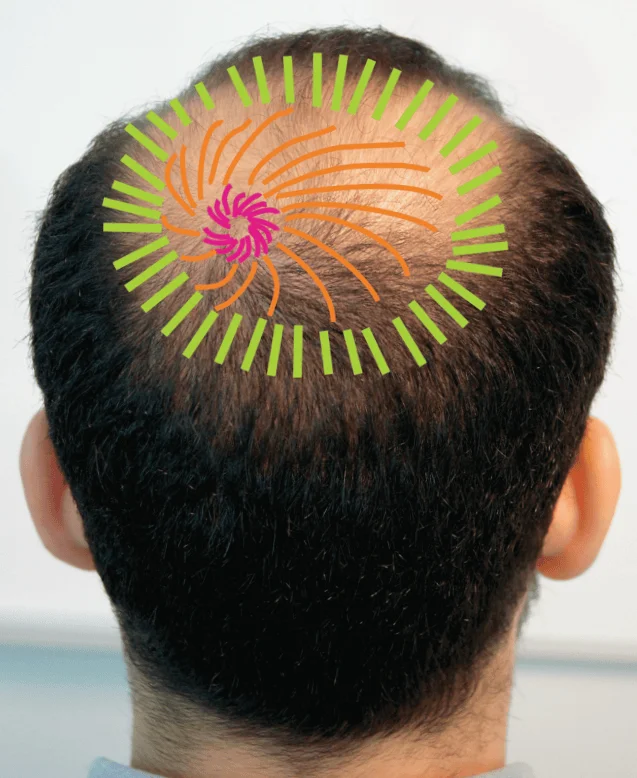
Because the hairs fan outward in different directions, the crown can show more scalp than other areas, even when a reasonable amount of hair is still present.
Restoring the crown is not simply about filling in a bald spot. Each hair graft must follow the natural direction and angle of the surrounding hair so the whorl looks natural.
The crown can also require many hair grafts because of its size. If donor hair has already been used in other transplanted areas, or the crown is too large to fully restore in one surgery, an additional procedure may be performed later to address the remaining areas. In some cases, patients are happy simply reducing the size of the crown, making it less noticeable and easier to manage without using an excessive number of grafts.
Crown Transplants In Younger Men
The crown requires extra consideration, especially in younger men, because hair loss in this area can continue to expand over time. If a small thinning crown is transplanted too early, the surrounding non-transplanted hair may continue to disappear, eventually leaving an isolated area of transplanted hair surrounded by thinning or bald scalp. This can create an unnatural “island,” “ring,” or “halo” appearance. The crown can also require a large number of grafts, potentially using valuable donor hair that may be needed in the future.
As a general guideline, we are more cautious about transplanting the crown in men under approximately age 35 because it may still be difficult to predict how large the area of hair loss will eventually become. However, age 35 is not a strict cutoff. Your pattern and stability of hair loss, response to medical treatment, family history, and donor supply are more important than age alone when determining whether the crown should be transplanted.