
Hair transplant surgery involves several carefully planned steps: evaluating your hair loss, determining the best approach for your individual needs, carefully harvesting and protecting donor hair grafts, properly designing and placing the grafts, and guiding you through recovery. Although different techniques may be used to harvest donor hair, the overall goal is the same: to create the greatest natural-looking visual improvement with the donor hair you have available.
Your Personalized Consultation
Every hair transplant begins with a thorough consultation. This includes evaluating your type and pattern of hair loss, how it has progressed, your medical history, scalp health, bloodwork, and the quality and availability of your donor hair. The goal is to determine whether you are a good candidate for surgery and whether the timing is right.
We also discuss treatments that may help stabilize ongoing hair loss, estimate the number of hair grafts you may need, review the surgical options available to you, and set realistic expectations before creating a personalized surgical plan.
Think of the consultation as the blueprint for your procedure. Hair transplant planning should be individualized, not based only on a hair graft number.
FUT vs. SmartGraft™ FUE: The Key Differences
FUT and FUE are two different ways of obtaining hair from the donor area. Both can produce excellent, natural-looking results when performed correctly. The better option depends on your donor area, hair characteristics, goals, and surgical plan.
Comparison
| Comparison | FUT | SmartGraft™ FUE |
| How grafts are removed | A narrow strip of hair-bearing scalp is removed, then carefully divided into individual follicular units under magnification. | Individual follicular units are removed one at a time using a small circular punch with motorized, suction-assisted extraction. |
| Donor area preparation | Only a narrow strip of donor hair needs to be trimmed short. | The donor area is shaved short so individual follicular units can be safely removed. |
| Scarring | Leaves a thin, linear scar. | Leaves multiple small, round scars distributed throughout the donor area. |
| Grafts available in one surgery | Depends on donor area size and density, scalp flexibility, and previous surgery or scarring. | Depends on donor area size and density, hair characteristics, how much can be safely extracted, and previous surgery or scarring. |
| Hairstyle considerations for scar coverage | Hair can usually be worn about ½ to 1 inch or longer to help conceal the linear scar. | Allows more flexibility with shorter hairstyles, often about ⅛ inch or longer, although very short or shaved hair may reveal extraction scars. |
No hair transplant is truly scarless. FUT and FUE simply create different types of scars. How noticeable they are depends on the technique, healing, donor hair characteristics, number of procedures you’ve had, and how short the hair is worn.
Follicular Unit Transplantation (FUT)
FUT, sometimes called the strip method, removes a narrow strip of hair-bearing scalp from the donor area. The strip is then carefully divided under magnification into individual follicular units for transplantation.
- A narrow section of donor hair is trimmed short.
- The strip is carefully removed.
- The donor area is closed with stitches, which are generally removed 10–14 days later.
- The permanent linear scar is typically thin and concealed by surrounding hair.
- Scalp tension, healing characteristics, previous surgery, strip size, and surgical technique can all influence the final scar.
How Much Hair Can Be Obtained With FUT?
The number of grafts available from a FUT procedure depends on several factors:
- Donor density
- Size of the safe donor area
- Scalp elasticity and mobility
- Previous hair transplant surgery or scarring
- How much donor hair can be safely removed without creating excessive tension or compromising future options
A patient with a larger, denser donor area and good scalp mobility may yield more grafts than someone with lower density or a tighter scalp. The strip width and length therefore have to be planned for the individual patient rather than chosen from a standard formula.
Follicular Unit Excision (FUE)
FUE removes follicular units individually rather than removing a strip of hair. Small circular punches, generally less than 1 mm, are used to score the skin around individual follicular units so they can be carefully extracted.
How FUE Works
- The donor area is shaved short so the direction and angle of the hairs can be clearly seen.
- A small circular punch is positioned around selected follicular units.
- Each follicular unit is carefully loosened and removed.
- Extractions are distributed throughout the safe donor area to help preserve an even appearance.
The small extraction sites, typically less than 1 mm in diameter, heal without stitches and leave tiny, round scars that are usually difficult to see once healed.

Two weeks post-op*
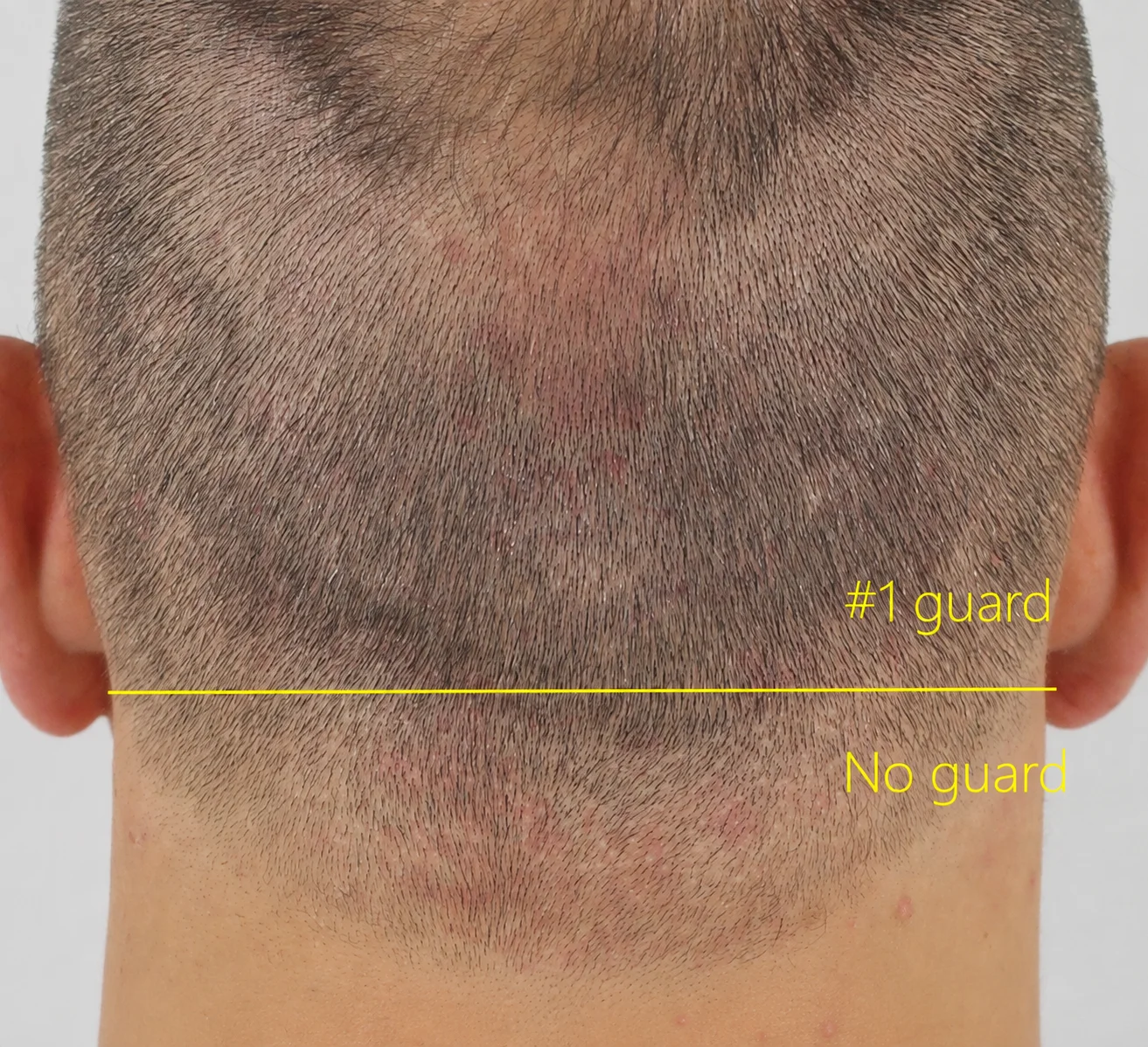
Why FUE Requires Precision
Hair follicles do not always grow straight down beneath the skin. Their angle and curvature vary, and skin thickness and tissue characteristics also differ between patients. The punch must follow the follicle carefully to reduce the chance of cutting or damaging the hair graft.
FUE Donor Area Management
Only a portion of the donor hair follicles should be removed during a procedure. How many can be safely harvested depends on donor density, the size of the safe donor area, hair caliber and texture, scalp characteristics, and whether you’ve had previous procedures. Removing too many grafts can leave permanent thinning or a moth-eaten appearance.
SmartGraft™ FUE Technology
SmartGraft™ is the FUE system used in our practice. It combines a small, motorized punch with controlled suction to assist with individual follicular unit extraction.
How SmartGraft™ Works
- A small circular punch makes a shallow score around the selected follicular unit.
- Controlled suction helps move the graft through a closed tubing system.
- The grafts are collected in a temperature-controlled, hydrated environment until they are prepared for implantation.
These features are designed to help keep grafts organized, hydrated, and protected while they are outside the scalp.
SmartGraft™, like other FUE devices, is a tool. The final result still depends on proper patient selection, surgical planning, donor management, surgical skill, and postoperative care.
Combination Hair Transplant Surgery: FUT + SmartGraft™ FUE
For selected patients who need a larger number of grafts, FUT and FUE may be combined over two consecutive days. FUT is performed on the first day, followed by FUE on the second day, allowing two procedures to be completed with a single recovery period. Using both donor-harvesting methods can increase the number of grafts available while distributing the donor impact between a linear strip and individual FUE extractions.
Hair Follicle Inspection and Sorting
After the grafts are removed—whether by FUT or FUE—they are inspected and prepared before implantation.
- Trimmed and cleaned: Excess tissue is carefully removed when needed.
- Sorted by hair count: Follicular units are grouped according to the number of hairs they contain, commonly from 1 to 4 hairs.
- Kept hydrated: Grafts are protected in an appropriate holding solution until implantation.
PRP During Hair Transplant Surgery
We use Platelet Rich Plasma (PRP), prepared from a small sample of your own blood, as an additional treatment during surgery. PRP contains concentrated platelets and growth factors that may help support healing and hair growth.
Creating the Recipient Sites: Where Surgical Design Matters
After the grafts have been prepared, tiny openings called recipient sites are carefully created in the areas being restored using small surgical blades or needles. The angle, direction, depth, and spacing of these sites help determine where and how each graft will grow, making this one of the most important steps in creating a natural-looking result.
For every area, we consider:
- Angle: How flat or upright the hair should emerge from the scalp
- Direction: The natural path the hair should follow
- Depth: How the graft should sit within the recipient site
- Spacing and density: How the grafts are distributed to create coverage while protecting the scalp and existing hair
These characteristics change throughout the scalp. Rather than using one fixed angle for everyone, the recipient sites should reproduce the patient’s existing hair direction and the natural pattern of each region.
Natural Hair Growth Patterns by Region
- Hairline: Hairs generally exit at a shallow angle and are directed forward. Mostly single hair grafts are used along the leading edge for softness.
- Temples: Hairs lie very flat against the scalp and follow the natural temporal direction.
- Frontal scalp: The hairs gradually become more upright as they transition away from the hairline.
- Midscalp: Direction and angle continue to change as the hair flows toward the crown.
- Crown: Hair follows a circular or spiral whorl. Careful graft placement should follow this natural growth pattern to create a crown that blends seamlessly with the surrounding hair.
Hair Graft Placement
Once the recipient sites are created, each follicular unit graft is carefully placed into its planned location, following the design created for that area.
Graft placement is a delicate process because the follicles are small and fragile. Each graft must be handled carefully and inserted without damaging the follicle, while also making sure it sits properly within the site to give it the best chance to grow.
Getting Graft Depth Right
Hair grafts need to sit securely and naturally within the recipient sites. If a graft is placed too deeply, it can contribute to pitting or an uneven appearance. If it is too shallow, it may not sit properly and can contribute to a raised or uneven surface. Careful placement helps the scalp heal smoothly and allows the hair to emerge naturally.
What to Expect on Surgery Day
Comfort During Surgery
Local anesthesia is used to numb the donor and recipient areas, similar to the numbing medication used during dental procedures. Oral medication and nitrous oxide may also be offered to help you relax. Once the scalp is numb, patients can watch television, listen to music, rest, or sleep during portions of the procedure.
Procedure Time
Hair transplant surgery can take several hours. In our practice, procedures commonly last about 4 to 10 hours depending on the number of grafts, the harvesting method, and the complexity of the case.
Recovery and Hair Growth Timeline
Pain and Downtime
Most patients describe the postoperative discomfort as manageable. Mild tenderness, tightness, swelling, or sensitivity, mainly to the donor area, can occur during the first several days. Patients are up and walking around immediately after surgery and can usually perform normal, light daily activities.
Many patients return to desk work within a few days, although some prefer to take about a week off while swelling, redness, and small scabs improve. Light exercise can generally be resumed after about one week, while strenuous exercise, swimming, and other activities should be avoided longer based on your postoperative instructions. You will also receive guidance on when you can wash your hair normally, wear a hat, sleep normally, get a haircut, and return to other regular activities.
Recovery varies depending on whether FUT or FUE was performed and the size of the procedure, so your specific postoperative instructions should always be followed.
The First 7–10 Days
Small scabs form around the transplanted hair grafts and donor area (for FUE) and gradually come off as the scalp heals.
Mild redness, swelling, tenderness, or itching can occur during the early healing period.
The Shedding Phase
Many of the transplanted hair shafts shed during the first several weeks. This is expected. The transplanted follicles (hair seeds) remain beneath the skin and later begin producing new hairs.
Regrowth Milestones
Around 3–4 months: Early new growth may begin.
Around 6 months: Noticeable growth and thickening are usually underway, although the result is still developing.
Around 12–18 months: Most patients are approaching their mature result. Crown growth may take longer than growth in the frontal scalp.
Hair growth varies from person to person, so these timeframes are general expectations, not guarantees.
Possible Complications of Hair Transplant Surgery
Hair transplant surgery is generally considered safe when performed on an appropriate patient by a properly trained surgical team, but no surgical procedure is risk-free. Most complications are uncommon and can often be minimized through careful planning, sterile technique, proper surgical execution, and following postoperative care guidelines. Possible complications can include infection, prolonged swelling, bleeding, folliculitis, and temporary shedding of existing hair around the transplanted area, numbness or reduced scalp sensation, poor hair growth, and noticeable scarring.