
The Real Challenge: Supply vs. Demand
For many patients, one of the biggest challenges in hair transplant surgery is that donor hair is limited, while the area of hair loss can be very large.
How much hair you need to look full also varies from person to person. Hair can provide more or less coverage depending on:
- Hair thickness—thicker hairs provide more coverage
- Hair texture—curly or wavy hair can cover more scalp than straight hair
- Hair and scalp color—less contrast between the two can make the scalp less noticeable
This is why two people with the same number of hairs can look very different in terms of fullness.
How Much Density Is Needed to Look Full?
A normal scalp, on average, may have approximately 80–120 follicular units per cm², but a hair transplant does not need to recreate that original density to look natural.
In many patients, approximately 35–40 follicular units per cm² can provide good visual coverage without recreating the scalp’s original density. In some areas, even fewer grafts may be needed, especially when existing hair remains and contributes to the overall appearance of fullness.
For example, if a thinning area still has 20 FU/cm² and we add 20 FU/cm², the combined density becomes approximately 40 FU/cm². That can make a significant visual difference without trying to replace every hair that was lost.
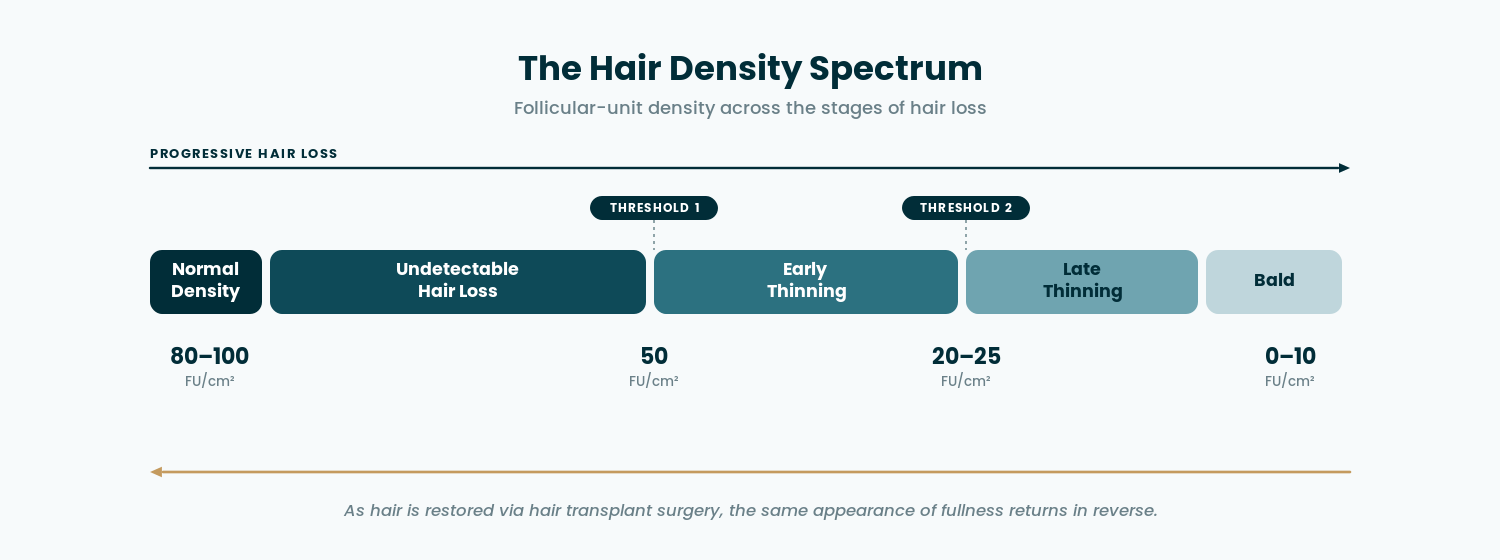
You don’t need to recreate your original density to make hair look full. Hair thickness, texture, curl, color, direction, and how the grafts are strategically placed all influence how much scalp you see.
Think of it as “real-world fullness”—how your hair looks across the table, in photographs, and during normal everyday activities.
Why Not Pack In as Many Grafts as Possible?
Each transplanted graft needs a healthy blood supply to survive. Placing grafts extremely close together creates more incisions in a small area and, at very high densities, may interfere with blood flow and healing.
It can also use valuable donor hair unnecessarily. Once donor grafts are moved, they cannot be replaced, so we need to think about not only how your hair looks today, but also what you may need in the future.
And because every patient’s donor supply, hair characteristics, existing density, area of hair loss, and future hair loss pattern are different, there is no single graft density that is right for everyone.
Some Scalp Visibility Is Normal
Even naturally dense hair can show some scalp when it is wet, separated, viewed very close up, or under bright overhead lighting. A successful transplant is not designed to make the scalp invisible under every possible condition.
Social media photographs can also create unrealistic expectations because lighting, styling, camera angle, and image editing can dramatically change how dense hair appears.
What Determines How Full Your Hair Transplant Will Look?
A successful hair transplant depends on much more than the number of grafts.
Size of the Area & Existing Hair
The larger the area being restored, the more grafts are needed to cover it. How much natural hair remains also matters—the more existing hair you have, the more it can contribute to the overall appearance of fullness.
Hair Characteristics & Quality
Your hair itself also affects how full a transplant can look. Thicker hair, curly or wavy hair, more hairs within each follicular unit, and less contrast between your hair and scalp can create the appearance of greater density with fewer grafts. Fine, straight hair or greater contrast may require more grafts to create a similar visual effect.
Donor Hair Availability
The amount of donor hair that can be safely harvested during your procedure also affects what can be achieved. When more donor hair grafts are available, we may be able to create greater fullness, cover a larger area, or both. If fewer grafts are available, we may concentrate them in the areas where they will provide the greatest visual improvement or plan an additional procedure when appropriate.
Scalp Health & Blood Supply
A healthy scalp provides the best environment for transplanted hair to grow. Significant scarring, previous injury, extensive sun damage, or active scalp conditions can affect how many grafts can be safely placed because these areas may have less healthy tissue or blood flow to support the newly transplanted hairs.
Overall Health & Nutrition
Good overall health supports proper healing. Conditions such as poorly controlled diabetes, uncontrolled high blood pressure, significant heart or vascular disease, bleeding or clotting disorders, and certain active inflammatory or autoimmune conditions may need to be well controlled before surgery.
Low-calorie diets, not eating enough protein, or significant nutrient deficiencies can affect hair growth because your body needs enough energy, protein, vitamins, and minerals to build and maintain healthy hair. When these are lacking, the body may prioritize more essential functions and reduce the resources available for hair growth and healing.
Tobacco & Nicotine
Nicotine can reduce blood flow and slow healing. We recommend stopping smoking, vaping, and all nicotine products at least 4 weeks before surgery and avoiding them for 2–4 weeks afterward.
Proper Aftercare
During the early healing period, your new hair grafts need a little extra care. Avoiding scratching, rubbing, too much sun, and certain activities while the scalp heals helps protect the transplanted hairs. Following your postoperative instructions is an important part of achieving the best result.