
Dutasteride is one of the most powerful medications available for lowering DHT, the hormone that plays a major role in male pattern hair loss.
How Was Dutasteride Developed?
Oral dutasteride 0.5 mg was originally FDA-approved to treat benign prostatic hyperplasia (BPH), or an enlarged prostate. Researchers later studied it for male pattern hair loss because the same DHT pathway involved in prostate growth also contributes to hair follicle miniaturization.1 It is not FDA-approved for hair loss in the United States, so its use for androgenetic alopecia is off-label. However, dutasteride 0.5 mg is approved for male pattern hair loss in countries including South Korea and Japan.1
For some men, especially those who continue losing hair despite consistent finasteride treatment, dutasteride can provide stronger DHT suppression and greater average hair growth improvement.
How Does Dutasteride Work?
Your body naturally converts free testosterone into another hormone called dihydrotestosterone, or DHT.
In men who are genetically prone to male pattern hair loss, certain hair follicles are sensitive to DHT. Over time, those follicles can shrink and produce hair that is thinner, shorter, and less visible.
Dutasteride slows this process by blocking the enzymes the body uses to make DHT.
There are two main forms of the 5-alpha-reductase enzyme: Type I and Type II.
There is also a third form of the 5-alpha-reductase enzyme, called Type III. However, its role in hair loss is not well established.
Finasteride mainly blocks type II, while dutasteride blocks both type I and type II. In clinical research, dutasteride produced stronger scalp and blood DHT suppression and greater hair growth compared with finasteride.2
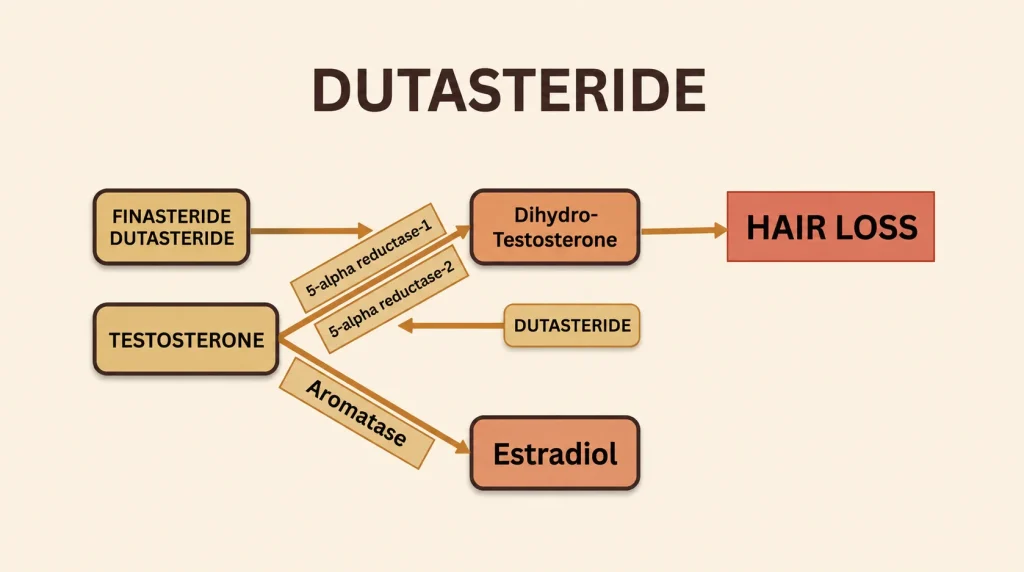
With continued oral dutasteride 0.5 mg treatment, DHT in the bloodstream can decrease by about 90% or more. Like finasteride, dutasteride does not lower testosterone; it reduces how much testosterone is converted into DHT.1
Oral Dutasteride
Oral dutasteride 0.5 mg once daily has a large body of clinical evidence for male pattern hair loss, although it remains off-label for hair loss in the United States.
How Effective Is Oral Dutasteride in Men?
A randomized, double-blind Phase III study included 153 men with male pattern hair loss who received oral dutasteride 0.5 mg daily or placebo for 24 weeks. Dutasteride produced significantly better hair growth based on hair counts, patient assessments, and investigator and photographic evaluations, with no major difference in overall adverse events between groups.3
One of the largest direct comparisons randomized 917 men with androgenetic alopecia to different oral dutasteride doses, oral finasteride 1 mg, or placebo for 24 weeks. Dutasteride 0.5 mg produced significantly greater increases in hair count and hair thickness than finasteride 1 mg, while the number and severity of adverse events were similar among treatment groups.4
A separate study in men ages 18–40 also found that oral dutasteride 0.5 mg improved total hair count and thick hairs more than oral finasteride 1 mg while reducing thin, miniaturized hairs to a greater degree.5
A newer systematic review that included nine studies—seven involving only men and two that included women—also concluded that dutasteride generally produced greater hair growth improvement than finasteride.6
A 2025 network meta-analysis combined 33 studies of male androgenetic alopecia and compared 19 treatment options, including oral and topical minoxidil, oral and topical finasteride, oral dutasteride, and dutasteride mesotherapy. Oral dutasteride 0.5 mg daily ranked as the most effective overall treatment for improving hair density. This large-scale analysis strengthens the overall evidence that oral dutasteride is among the most effective medical treatments studied for male pattern hair loss.7
Does This Mean Everyone Taking Finasteride Should Switch?
No.
If finasteride has stopped or significantly slowed your hair loss, you tolerate it well, and you are happy with your results, there may be no reason to change treatment.
Dutasteride may be worth considering when:
- Hair loss continues despite consistent finasteride treatment
- Finasteride has produced only a limited response
In a study of 31 men whose hair loss had not improved enough with oral finasteride, switching to oral dutasteride 0.5 mg daily increased hair density by about 10% and hair thickness by about 19% after six months.8
The goal is not simply to block as much DHT as possible. Male pattern hair loss depends on how sensitive your hair follicles are to DHT, among other complex factors, so treatment should balance effectiveness, safety, convenience, and long-term tolerability.
What Dose of Oral Dutasteride Is Used for Hair Loss?
Dutasteride 0.5 mg once daily has the most clinical evidence for male pattern hair loss.
Lower doses are also being studied. A 2025 multicenter Phase III trial randomized 139 men to oral dutasteride 0.2 mg, oral dutasteride 0.5 mg, or placebo for 24 weeks. The 0.2 mg dose significantly improved hair count compared with placebo and produced results similar to 0.5 mg across the study’s main effectiveness measurements, while lowering serum DHT less strongly.9
This suggests that some men may respond to a lower dose, but dutasteride 0.5 mg still has considerably more long-term clinical experience behind it.
Doses higher than 0.5 mg daily are not routinely used for hair loss. Although higher doses can suppress DHT further, they have not been shown to provide better hair growth results than 0.5 mg daily. For this reason, increasing the dose above 0.5 mg is generally not necessary for treating hair loss.
Does Dutasteride Have to Be Taken Every Day?
Possibly not for every patient.
Because dutasteride has an average half-life of approximately 5 weeks—meaning it takes about 5 weeks for the amount of medication in the body to decrease by half—it remains in the body much longer than many medications. This is why researchers have begun studying whether dutasteride can still be effective when taken less frequently than every day.
A 2025 randomized pilot study included 60 men ages 21–60 and compared oral dutasteride 0.5 mg twice weekly, dutasteride 0.5 mg three times weekly, and oral finasteride 1 mg daily for 24 weeks. All three groups improved. Three-times-weekly dutasteride generally produced stronger hair-growth results than twice-weekly dosing and encouraging results compared with daily finasteride.10
This is useful early evidence, but the study was small and lasted only 24 weeks. We do not yet have the same long-term evidence for intermittent dosing that we have for daily dutasteride.
Why Does Dutasteride’s Long Half-Life Matter?
Due to its longer half-life, dutasteride can remain in the bloodstream for about 4–6 months after treatment stops.1
This has both advantages and disadvantages:
- Missing an occasional dose is unlikely to cause DHT levels to suddenly return to normal
- If a medication-related side effect develops, the medication’s effects may also take longer to wear off
This does not mean a side effect will necessarily last for months. It means the medication itself takes much longer to leave the body.
Topical Dutasteride
Topical dutasteride is being studied as a way to deliver medication directly to the scalp while reducing the amount that reaches the bloodstream.
How Effective Is Topical Dutasteride?
A 2025 randomized, double-blind Phase II trial included 135 men ages 20–60 with androgenetic alopecia. Researchers compared three strengths of topical dutasteride—0.01%, 0.02%, and 0.05%—with placebo and oral finasteride 1 mg daily for 24 weeks.
The results improved as the strength of topical dutasteride increased. The strongest formulation, topical dutasteride 0.05%, produced significantly more hair growth than placebo and, based on the study’s primary hair-count measurement, also performed better than oral finasteride 1 mg after 24 weeks. Topical dutasteride also had less effect on hormone levels in the bloodstream than oral finasteride.11
Not all topical dutasteride formulas work exactly the same. The strength, amount applied, ingredients in the formula, and condition of the scalp can all affect how much medication reaches the hair follicles and how much enters the bloodstream.
Oral vs. Topical Dutasteride: How Do They Compare?
Both can lower DHT and support hair growth, but there are important differences.
Oral Dutasteride
- Has the strongest and longest clinical evidence
- Usually taken as a 0.5 mg capsule
- Provides consistent dosing
- Produces strong systemic DHT suppression
- Is generally simple and convenient to use
- Creates more systemic exposure than topical treatment
Topical Dutasteride
- Applied directly to the scalp
- Has encouraging short-term clinical evidence
- May reduce systemic exposure compared with oral treatment
- Still may enter the bloodstream and affect bloodstream DHT
- Can cause scalp irritation or buildup depending on the formulation
- Requires consistent application to the scalp
Can Dutasteride Be Combined With Other Treatments?
Yes. Dutasteride lowers DHT, but it does not address every part of the hair loss process. It may be combined with treatments that work through different pathways, such as minoxidil, PRP, or low level laser therapy, when appropriate.
The goal is not to use as many treatments as possible. It is to combine treatments only when each one adds a different, useful benefit.
How Quickly Does Dutasteride Work?
Dutasteride starts lowering DHT quickly, but hair grows slowly. Results should be judged in months, not weeks.
First 1–3 months: It is usually too early to judge the final response.
3–6 months: Some men begin to notice less shedding, greater stability, or early improvement.
6–12 months: Changes are usually easier to see in photographs and scalp examinations.
12 months and beyond: Continued treatment can help maintain the hair being protected, and some patients continue to improve over time.
A five-year Korean follow-up study of men taking oral dutasteride 0.5 mg found sustained clinical benefit over time.12
What Happens if You Stop Dutasteride?
A common myth is that stopping dutasteride permanently makes your hair loss worse than it would have been if you had never taken it. This is a common misconception.
Dutasteride helps protect DHT-sensitive hair follicles, but it does not cure the underlying genetic tendency to lose hair. When treatment stops, the medication gradually leaves the body, DHT eventually rises again, and the hair loss process can resume.
Because dutasteride remains in the body for months, this usually happens more slowly than it does after stopping finasteride.1
Think of dutasteride like medication used to manage another chronic condition. The treatment controls the problem while you use it, but it does not permanently remove the underlying condition. Continued treatment is generally needed to maintain the benefit.
Dutasteride Side Effects: Putting the Risk Into Perspective
Most men taking dutasteride for hair loss do not experience sexual side effects. However, sexual side effects can occur and should be taken seriously when they develop.
What Sexual Side Effects Can Occur?
- Decreased sex drive
- Difficulty getting or maintaining an erection
- Changes in ejaculation
- Decreased semen volume
Does Dutasteride Cause More Sexual Side Effects Than Finasteride?
Stronger DHT suppression with dutasteride has not consistently translated into more sexual side effects than finasteride.
In the 917-male randomized study, oral dutasteride 0.5 mg produced greater hair growth than oral finasteride 1 mg, while the number and severity of adverse events were similar among groups.4
Another study specifically examined sexual function in 117 men ages 23–50 with androgenetic alopecia. During the 24-week period, sexual adverse events occurred in approximately 16% of men taking oral dutasteride 0.5 mg compared with 8% taking placebo. The events were generally mild to moderate and improved either during treatment or after treatment stopped.13
Taken together, the evidence shows that dutasteride can cause sexual side effects, but current studies have not shown a large or consistent increase compared with finasteride.
Sexual Side Effects Can Have Many Causes
If decreased libido or erectile dysfunction develops while taking dutasteride, the medication should be considered—but timing alone does not prove that dutasteride is the cause.
Sexual function can also be affected by cardiovascular disease, high blood pressure, diabetes, insulin resistance, obesity, low testosterone, thyroid disorders, sleep apnea, depression, anxiety, stress, smoking, heavy alcohol use, neurologic disease, prostate conditions, and other medications.
That is why a new sexual symptom should not automatically be blamed on dutasteride or automatically dismissed as unrelated. Both possibilities deserve consideration.
Dutasteride, Mood, Depression, and Suicidal Thoughts
Depression and anxiety are common and can have many causes, including genetics, stress, health conditions, medications, hormones, and life circumstances. Hair loss itself can also affect emotional well-being.
A 2025 retrospective database study specifically evaluated men with androgenetic alopecia treated with finasteride or dutasteride and found no increased risk of mood disorders with either medication.14
Mood changes should still be taken seriously. If you develop new or significant depression, anxiety, or suicidal thoughts while taking dutasteride, contact your prescribing physician.
Can Sexual Side Effects Continue After Stopping Dutasteride?
Persistent sexual symptoms have been studied much more extensively with finasteride than with dutasteride.
Controlled dutasteride hair loss studies generally found that sexual side effects improved during continued treatment or after the medication was stopped.4,13
Current evidence does not show that persistent sexual dysfunction is a common outcome of dutasteride treatment for hair loss. However, because dutasteride remains in the body for a long time, we cannot predict exactly how quickly every medication-related symptom will improve after stopping treatment.
Does Dutasteride Affect Male Fertility?
Dutasteride deserves additional consideration when fertility is an active concern.
A randomized study in healthy men compared oral dutasteride 0.5 mg, finasteride 5 mg, and placebo. Dutasteride was associated with decreases in total sperm count, semen volume, and sperm motility during treatment, although these changes do not mean that every man becomes infertile.15
Newer research also suggests that treatment duration may matter. A 2025 study of young men taking oral dutasteride for androgenetic alopecia found that longer treatment was associated with a greater likelihood of persistent reductions in semen volume and sperm motility after stopping treatment.16
This does not prove that long-term dutasteride commonly causes permanent infertility. It does mean that men with a low sperm count, abnormal semen analysis, or difficulty conceiving deserve a more individualized discussion.
For men who are concerned about fertility before starting dutasteride, a semen analysis can be performed beforehand to establish a baseline.
Can Men Take Dutasteride While Trying to Have a Baby?
A very small amount of dutasteride can be found in semen, but the amount a female partner would be exposed to is extremely low. There is currently no evidence that a man taking dutasteride increases the risk of birth defects in his baby.
For a man with normal fertility who is not having difficulty conceiving, dutasteride does not automatically need to be stopped solely because his partner is trying to become pregnant. If conception is taking longer than expected or a semen analysis is abnormal, the medication should be reviewed as one possible contributing factor.
Because dutasteride has a very long half-life, fertility planning may require more time if treatment is discontinued.1
How Does Dutasteride Affect PSA Blood Tests?
Dutasteride lowers PSA, a blood test commonly used to help evaluate prostate health.
With oral dutasteride 0.5 mg daily, PSA typically decreases by about 50% within 3–6 months. Because of this, your physician needs to know you are taking dutasteride so your PSA result can be interpreted correctly. After starting treatment, a new PSA baseline should be established, and any confirmed increase from your lowest PSA level should be evaluated.1
Always tell your physician reviewing your PSA that you take dutasteride. Otherwise, the medication can make your PSA appear lower than it would be without treatment.
Can You Donate Blood While Taking Dutasteride?
If you are taking dutasteride, you should not donate blood for transfusion. The American Red Cross requires waiting six months after the last dose because dutasteride remains in the body for a long time.17
If blood needs to be removed for medical reasons, such as therapeutic phlebotomy, this may still be possible through a facility that provides the service. When blood is not eligible for transfusion, it can be removed for treatment and discarded. A physician’s order may be required, and policies vary by facility.
Can Women Take Dutasteride for Female Pattern Hair Loss?
A three-year observational study followed 120 women with female pattern hair loss. Sixty women took oral finasteride 1.25 mg daily, and 60 took oral dutasteride 0.15 mg daily. Hair thickness increased in 81.7% of women taking finasteride and 83.3% taking dutasteride, and both treatments helped prevent further worsening.18
Dutasteride may therefore be an option for carefully selected women.
Does Dutasteride Increase Breast or Gynecologic Cancer Risk in Women?
A large population-based study identified 1,794,577 women with dermatologic conditions, including 13,853 who had used finasteride or dutasteride. After matching users and nonusers for important differences, finasteride or dutasteride use was not associated with an increased risk of breast or gynecologic cancers.19
Women with a personal history of breast cancer, particularly hormone-sensitive disease, should still discuss dutasteride with their treating physicians before starting treatment.
What if a Woman Is Taking Dutasteride?
Dutasteride should not be used during pregnancy because it lowers DHT, a hormone needed for the normal development of a male baby’s genitalia. This creates a theoretical risk that dutasteride exposure during pregnancy could interfere with normal genital development. This concern is based mainly on how dutasteride works and findings from animal studies; birth defects from dutasteride exposure have not been documented in human pregnancies.
Pregnant women, or women who may become pregnant, should not handle leaking dutasteride capsules because the medication can be absorbed through the skin. If accidental contact occurs, wash the exposed area immediately with soap and water.
Women who could become pregnant while taking dutasteride off-label for hair loss should use reliable contraception and discuss pregnancy plans with their prescribing physician.
Dutasteride Mesotherapy
Dutasteride mesotherapy involves injecting small amounts of dutasteride directly into the scalp. The goal is to place medication close to the follicles while reducing systemic exposure.
A 2022 study included 541 patients—both women and men—who received dutasteride mesotherapy for androgenetic alopecia. The most common schedule during the first year was treatment every three months. Among 86 patients who could be evaluated on mesotherapy alone after one year, 38.4% had marked improvement. No serious or sexual adverse events were identified in that study.20
More recent evidence is less enthusiastic about mesotherapy than some of the earlier studies. In the 2025 meta-analysis of 33 studies, dutasteride mesotherapy was significantly less effective than oral dutasteride 0.5 mg daily for improving total hair density. This does not mean mesotherapy has no benefit, but it suggests that injecting dutasteride into the scalp should not be assumed to work as well as established oral treatment.7
Can Dutasteride Be Used After Hair Transplant Surgery?
Dutasteride can be especially helpful before and after a hair transplant.
A hair transplant replaces hair that has already been lost, but surgery does not stop the surrounding, non-transplanted hair from continuing to thin.
Dutasteride can help protect that existing hair by lowering DHT and slowing further thinning and loss. For many patients, surgery and medical treatment work together: the transplant replaces lost hair, while dutasteride helps protect the hair that remains.
Who May Be a Good Candidate for Dutasteride?
- Adult men with male pattern hair loss
- Men who continue losing hair despite consistent finasteride treatment
- Men who want to preserve as much existing hair as possible
- Men who may benefit from stronger DHT suppression
- Men who have had or are planning a hair transplant and want to protect their existing hair
- Selected women with female pattern hair loss when pregnancy is not a possibility and off-label treatment has been carefully reviewed
Who Should Talk With Their Physician Before Starting Dutasteride?
- Men who have fertility problems or a low sperm count
- Patients with significant baseline sexual dysfunction
- Patients with significant liver disease
- Patients who develop significant mood changes
- Women who are pregnant, planning pregnancy, or could become pregnant
Having one of these concerns does not automatically mean dutasteride cannot be used. It means the risks, alternatives, and monitoring deserve a more individualized discussion.
Where Dutasteride Fits Into a Long-Term Hair Loss Plan
Dutasteride is one of the most effective DHT-lowering medications studied for male pattern hair loss. It blocks both type I and type II 5-alpha-reductase and, on average, has produced greater hair-growth improvement than finasteride in several clinical studies.4,5,6
But stronger does not automatically mean better for every patient.
For some patients, success means visibly thicker hair. For others, it means keeping their hair stable and preventing further thinning. Sometimes the most important benefit is the hair that was preserved because treatment slowed the progression of a chronic condition.
Because genetic hair loss is chronic, hair may look better during some periods and thinner during others. Illness, nutrition, hormones, scalp inflammation, aging, medications, bloodwork abnormalities, and other causes of shedding can overlap with genetic hair loss.
This is why we evaluate hair over time using photographs and scalp examinations, along with blood work, nutrition, and an overall health review when appropriate. The goal is to determine whether the hair is improving, remaining stable, or continuing to miniaturize—and whether anything else needs to be addressed.
For patients who benefit from dutasteride, continued treatment is generally needed to maintain that benefit. Dutasteride controls an ongoing genetic process; it does not permanently cure it.
Be Careful With Online Stories
Reading about other people’s experiences online can be helpful, but one person’s story cannot tell you how common an outcome is or whether the same thing will happen to you. You also usually do not know that person’s complete medical history, other medications, hormone levels, underlying health conditions, or other factors that may have contributed to the symptoms.
One person’s experience does not mean you will have the same response. Treatment decisions are best based on good clinical evidence, your medical history, and how you personally respond to treatment.