
Topical Minoxidil
Minoxidil is a well-established hair loss medication that helps stimulate hair follicles, improve hair growth, and increase the thickness of thinning hair. It is available as a topical treatment applied to the scalp or as a low-dose oral medication, and it can be used alone or combined with other hair loss treatments depending on the cause of hair loss.
How Was Minoxidil Discovered?
Minoxidil has been used as an oral medication to treat severe high blood pressure since the late 1970s. Physicians noticed that some patients taking it developed increased scalp, facial, and body hair growth. This unexpected side effect eventually led researchers to investigate whether minoxidil could be applied directly to the scalp to stimulate hair growth.1
The FDA approved 2% topical minoxidil for male pattern hair loss in 1988 and later approved the 2% formulation for women in 1991. In 1997, the FDA approved 5% topical minoxidil solution for men, followed by 5% minoxidil foam for men in 2006.
In 2014, the FDA approved 5% minoxidil foam once daily for female pattern hair loss.
Minoxidil can also be prescribed off-label for several types of hair loss in both men and women. Off-label prescribing is common in medicine when research and clinical experience support using a medication for a purpose beyond its original FDA approval.2
Low-dose oral minoxidil is a good example. Although oral minoxidil was originally approved for high blood pressure, a growing body of research now supports much lower doses for several types of hair loss. An international group of 43 hair-loss specialists from 12 countries has also published consensus recommendations for its use.2
How Does Minoxidil Work?
Minoxidil’s effect on hair growth is more complicated than simply “increasing blood flow to the scalp.”
Before minoxidil can fully stimulate the hair follicle, the body converts it into its active form, called minoxidil sulfate. Once activated, minoxidil appears to support hair growth through several pathways.1
One way it works is by opening tiny channels in cells around the hair follicle called ATP-sensitive potassium channels. This changes signals within these cells in ways that may help support hair growth.1
Minoxidil may also activate the Wnt/β-catenin pathway, which plays an important role in turning on hair growth and helping hair follicles remain in their active growing phase longer.1,3
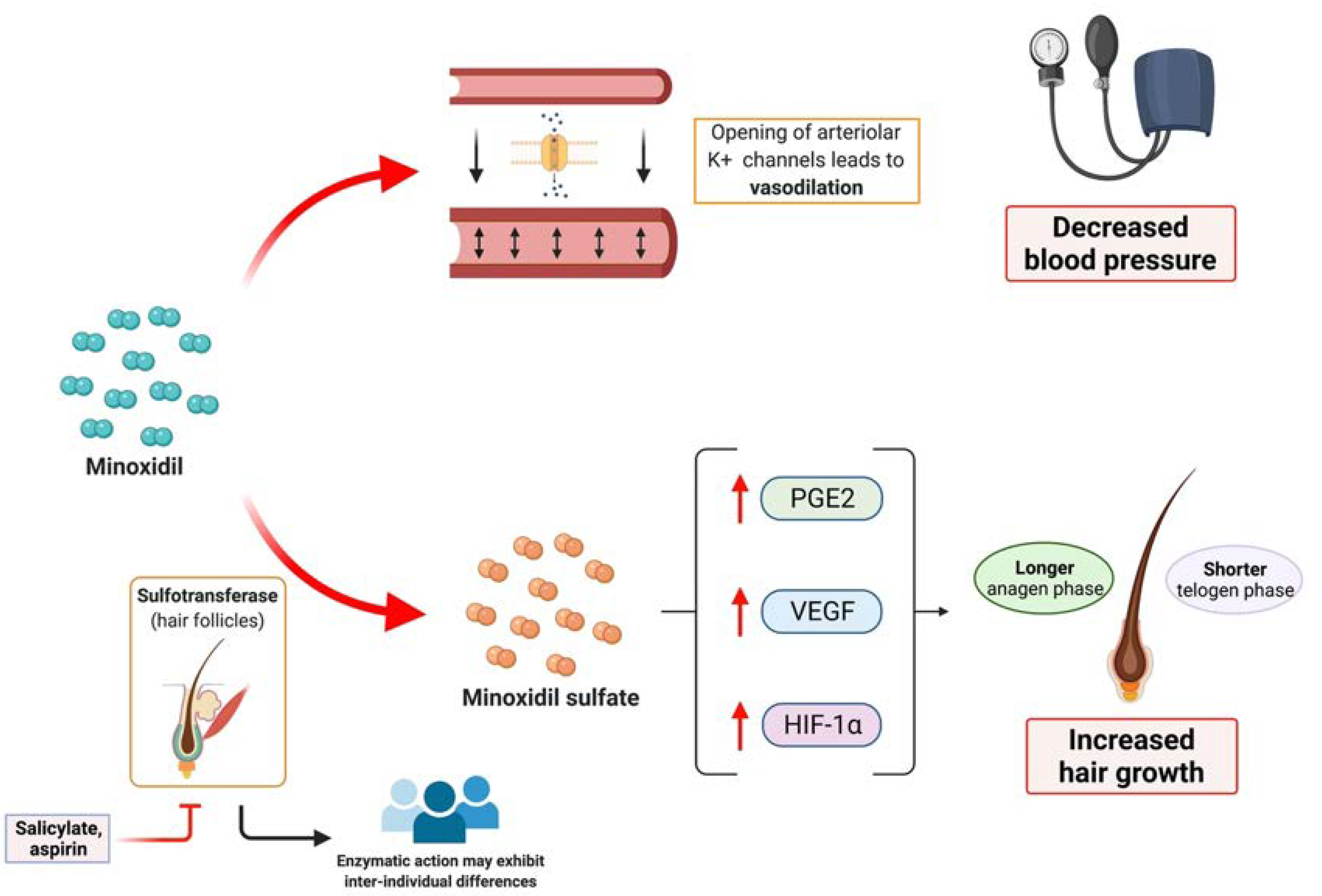
Minoxidil goals include:
- Move resting hairs into the growing (anagen) phase
- Keep hairs growing for longer
- Help some thinning hair follicles produce thicker hairs
Minoxidil Does Not Block DHT
Minoxidil mainly works by stimulating hair follicles and encouraging hair growth rather than by lowering DHT. In genetic hair loss, DHT binds to hair follicles that are genetically sensitive to it, gradually causing them to become smaller and produce thinner, shorter hairs over time.4
Laboratory studies suggest that minoxidil may have some effect on how hair follicles respond to DHT, but there is currently no good clinical evidence showing that it meaningfully lowers DHT or changes a hair follicle’s genetic sensitivity to it.5,6
For this reason, minoxidil can help stimulate hair growth but should not be considered a substitute for medications such as finasteride or dutasteride when reducing DHT is an important part of the treatment plan, especially for genetic pattern hair loss.
Topical Minoxidil
Topical minoxidil is designed to deliver the medication directly to thinning areas of the scalp, where it can act on the hair follicles while limiting how much reaches the bloodstream.
An early absorption study found that approximately 1.4% of an applied topical minoxidil dose was systemically absorbed, although absorption can vary depending on the formulation, amount applied, and your scalp condition. An irritated, inflamed, sunburned, or damaged scalp may absorb more topical minoxidil into the bloodstream than healthy skin.7
How Effective Is Topical Minoxidil in Men?
One landmark clinical trial included 393 men with male pattern hair loss who received 5% minoxidil, 2% minoxidil, or placebo.
After 48 weeks, men using 5% minoxidil experienced approximately 45% greater hair regrowth than men using 2% minoxidil. The 5% formulation also produced an earlier response, and both minoxidil concentrations performed better than placebo.8
This shows that minoxidil can do more than simply slow hair loss. Some men can experience meaningful thickening and regrowth.
How Effective Is Topical Minoxidil in Women?
This study followed 381 women with female pattern hair loss for 48 weeks.
Women received 5% minoxidil, 2% minoxidil, or placebo. Both minoxidil concentrations improved hair growth compared with placebo, while 5% minoxidil performed better than 2% on some measures of treatment benefit.9
Another randomized study involving 113 women found that once daily 5% minoxidil foam produced meaningful hair growth and provided a convenient alternative to twice-daily 2% solution.10
These studies helped support the eventual FDA approval of once daily 5% minoxidil for women in 2014.
Why Does Topical Minoxidil Work Better for Some People Than Others?
Minoxidil must first be converted into its active form, minoxidil sulfate, before it can fully stimulate the hair follicle. An enzyme called sulfotransferase helps make this conversion happen.
With topical minoxidil, this activation depends largely on sulfotransferase activity within the hair follicle. Because people naturally have different levels of this enzyme, some hair follicles are better at activating topical minoxidil than others. Research has shown that higher follicular sulfotransferase activity can help predict a better response to topical minoxidil.11
Oral minoxidil works differently. After the pill is absorbed, much of the medication can be converted into active minoxidil sulfate during metabolism in the liver, making it less dependent on the sulfotransferase activity within the scalp. Interestingly, a 2024 study found that patients with low scalp sulfotransferase activity responded better to oral minoxidil than those with high activity—85% compared with 43%.12
This suggests that someone whose scalp does not activate topical minoxidil very well may still respond to oral minoxidil because the oral medication can be activated elsewhere in the body.
Foam vs. Liquid Minoxidil: Which Is Better?
Both foam and liquid minoxidil can work. The better choice often depends on hair length, scalp sensitivity, styling preferences, and which formulation a patient is most likely to use consistently.
Liquid Minoxidil
Traditional liquid minoxidil formulas generally contain minoxidil, alcohol, water, and propylene glycol.
Propylene glycol helps keep minoxidil dissolved and assists with delivery through the skin.
Liquid can also be easier to measure and apply directly to the scalp, particularly for patients with longer or thicker hair.
Minoxidil Foam
Minoxidil foam was developed without propylene glycol, which can make it easier to tolerate for people whose scalp becomes irritated by liquid minoxidil.
Foam is not alcohol-free. Commercial minoxidil foam contains a relatively high concentration of alcohol. The alcohol helps keep minoxidil dissolved without propylene glycol and evaporates quickly, which is one reason the foam tends to dry faster and feel less greasy.
Because foam still contains alcohol, some patients can experience dryness or irritation even though it does not contain propylene glycol.
What Is Propylene Glycol?
Propylene glycol is a common inactive ingredient used in many medications, cosmetics, and personal-care products. It acts as a solvent, meaning it helps dissolve ingredients that do not easily mix with water. It is also used as a moisture-retaining ingredient and can help spread a product more evenly across the skin.
In liquid minoxidil, propylene glycol has several jobs:
- It helps keep minoxidil completely dissolved in the solution
- It helps the medication spread evenly across the scalp
- It helps minoxidil stay in contact with the skin long enough to be absorbed
- It can improve delivery of the medication through the outer layer of the scalp
Propylene glycol is also commonly found in products such as creams, lotions, shampoos, deodorants, cosmetics, and topical medications because of these same properties.
For most people, it is well tolerated. However, some people are sensitive to it and may develop itching, redness, burning, dryness, flaking, or contact dermatitis (irritated or allergic skin reaction). This is one reason some patients tolerate minoxidil foam better than liquid minoxidil, since many foam formulations do not contain propylene glycol.
A systematic review of allergic contact dermatitis caused by topical minoxidil found that reactions can result from either minoxidil itself or ingredients in the formulation, particularly propylene glycol.13
This means that someone who believes they cannot tolerate minoxidil may sometimes actually be reacting to the formulation rather than the medication itself.
Switching to a propylene-glycol-free preparation may help when propylene glycol is the problem.
Oral Minoxidil for Hair Loss
Low-dose oral minoxidil has become an increasingly popular off-label treatment for hair loss, especially when topical minoxidil is difficult to use or causes scalp irritation. Hair loss specialists had been prescribing it for years, but it gained much wider attention in August 2022, when The New York Times published an article titled “An Old Medicine Grows New Hair for Pennies a Day, Doctors Say.” The article explained how physicians were using much lower doses of oral minoxidil to help stimulate hair growth.
The story helped bring oral minoxidil into the mainstream. Research later showed a significant increase in public interest based on Google searches for low-dose oral minoxidil after the article was published, helping bring the treatment into much wider public awareness.14
It may be considered for patients who:
- Cannot tolerate topical minoxidil
- Develop scalp irritation with topical treatment
- Find applying medication every day inconvenient
- Have difficulty using topical treatment consistently
- Dislike residue or changes in hair texture
- Do not wash their hair regularly, which can allow the medication to build up on the scalp
- Have not seen enough improvement with topical minoxidil
What Dose of Oral Minoxidil Is Used for Hair Loss?
Published studies have used different doses of oral minoxidil depending on the patient:
- Women: Typically 0.25–2.5 mg daily
- Men: Typically 1–5 mg daily
There is no single dose that is best for everyone. An international group of 43 hair-loss specialists recommended choosing the dose based on the individual patient, including their medical history, other medications, response to treatment, and any side effects.2
More is not always better. The goal is to find the lowest dose that provides a good hair response while keeping side effects to a minimum.
How Effective Is Oral Minoxidil in Men?
A clinical trial directly compared oral minoxidil 5 mg once daily with topical minoxidil 5% twice daily in men with male pattern hair loss.
After 24 weeks, oral minoxidil was not superior overall for measurements on hair density or hair thickness. However, before-and-after photographs showed greater improvement at the crown with oral minoxidil.15
Oral minoxidil can work very well, but taking minoxidil by mouth does not automatically make it more effective than properly used topical minoxidil.
How Effective Is Oral Minoxidil in Women?
The evidence supporting low-dose oral minoxidil in women has grown considerably.
A clinical trial compared 1 mg of oral minoxidil daily with 5% topical minoxidil in women with female pattern hair loss. After 24 weeks, both treatments improved hair growth, with no clear overall winner. Women taking oral minoxidil, however, showed greater improvement in hair shedding.16
Researchers have also compared different oral doses in women. 1 mg daily produced better results than 0.25 mg daily, providing additional evidence that low-dose oral minoxidil can be an effective treatment for female pattern hair loss.17
Taken together, these studies support low-dose oral minoxidil as an effective treatment option for appropriately selected women.
Does a Higher Oral Dose Work Better?
A clinical trial in women compared 0.25 mg with 1 mg oral minoxidil daily and found a stronger hair response with the 1 mg dose.18
A more recent clinical trial compared 2.5 mg and 5 mg of oral minoxidil daily in men with male pattern hair loss. After 24 weeks, both doses produced similar improvements in hair growth. However, some men taking 5 mg experienced more swelling and dizziness.19
This suggests that increasing the dose does not always lead to better hair growth and may increase the risk of side effects.
Does Higher-Strength Topical Minoxidil Work Better?
Not necessarily.
5% topical minoxidil has the largest body of high-quality clinical evidence.
Higher compounded strengths such as 6%, 7%, 7.5%, 10%, and 15% have also been used, but increasing the concentration past a certain strength does not automatically mean more hair growth.
Clinical studies evaluating higher strengths have produced mixed results. One trial found that 5% topical minoxidil actually performed better than 10% minoxidil, while 10% caused more local irritation.20
A 2022 review examined higher-strength topical minoxidil and found a limit to how much minoxidil can stay completely dissolved in traditional formulas containing propylene glycol. At concentrations above approximately 7.5%, minoxidil becomes more difficult to keep dissolved and may begin to form crystals as the solution dries on the scalp. This means that simply increasing the percentage of minoxidil does not necessarily mean that more usable medication will be delivered to the scalp.21
Oral vs. Topical Minoxidil: Which Works Better?
A 2025 meta-analysis combined four randomized clinical trials involving 279 men and women with androgenetic alopecia, directly comparing oral and topical minoxidil. Researchers found no significant overall difference in hair density or hair diameter between oral and topical treatment. However, unwanted facial or body hair occurred more frequently with oral minoxidil.22
For many patients, the choice therefore comes down to:
- Convenience
- Scalp sensitivity
- Hair wash frequency
- Medical history
- Side effects
- Ability to remain consistent with treatment
- Patient preference
Neither form is automatically better for everyone.
Can Oral and Topical Minoxidil Be Used Together?
Yes. Some patients may use both oral and topical minoxidil.
However, there is not enough research to show that using oral and topical minoxidil together grows more hair than using either one alone. In clinical practice, hair loss specialists have seen patients improve when both are used together, particularly when one treatment alone has not provided enough improvement, or if compliance is an issue with topical formulations.
Does Minoxidil Cause Initial Hair Shedding?
Minoxidil can sometimes cause a temporary increase in shedding when treatment is first started. The purpose is to move older, weaker hairs that are already in the resting phase out sooner as the hair follicle transitions into a new growing phase, to make way for healthier, thicker, longer hair. This is sometimes called the “dread shed.”
It is also helpful to put shedding into perspective. Seeing more hair fall out can be alarming, and even a small increase can look and feel much worse than it actually is, especially when someone has recently started a new hair loss medication and is paying much closer attention to every hair they see. There is also no reliable way to predict how much shedding an individual will experience or exactly how long it will last.
How infrequently someone washes their hair can also make shedding appear worse. Hairs that have already detached from the hair follicle (hair root) may remain trapped within the surrounding hair until it is washed or brushed. Someone who washes every few days may therefore see several days’ worth of shed hairs come out at once, rather than the smaller amount they might see with daily washing. This does not necessarily mean they are losing hair faster.
Since minoxidil takes time to work, some continued shedding may be from the underlying hair loss rather than the medication itself. It is also important to find and treat the trigger(s) causing the hair loss, since minoxidil can support hair growth but does not fix the underlying cause.
A study comparing oral and topical minoxidil in men found temporary shedding during the first two months in approximately:
- 9% of men taking oral minoxidil
- 16% of men using topical minoxidil
How Quickly Does Minoxidil Work?
Hair grows slowly, so minoxidil should be judged over 6+ months rather than weeks.
First 1–3 months: Some patients may experience temporary shedding. It is usually too early to judge the final response.
3–6 months: Reduced shedding, stabilization, or early thickening may become noticeable.
6–12 months: Changes in hair density and thickness become easier to see.
12 months and beyond: Continued treatment can help maintain the hairs responding to minoxidil.
Regular before-and-after photographs, scalp examinations, proper nutrition, balanced bloodwork, and regular follow-ups provide a much better way to evaluate progress than looking in the mirror every day.
What Happens if You Stop Minoxidil?
A common myth is that stopping minoxidil makes your hair loss worse than it would have been if you had never started treatment. That is not what happens.
Minoxidil helps support hair growth, but it does not cure the underlying cause of hair loss. If you stop using it, the hairs that were benefiting from minoxidil may gradually shed, and over the following months, your hair can return to where it likely would have been without treatment. If your underlying hair loss continued to progress during that time, your hair may look thinner than you remember it being before starting minoxidil. This can make it seem like stopping minoxidil made things worse, when you are actually seeing the loss of minoxidil’s benefit plus the natural progression of your hair loss.
Think of minoxidil like medication used to manage a chronic condition. The treatment helps control the problem while you are using it, but it does not eliminate the underlying condition. If you stop treatment, you lose that support and the condition can continue its natural course. Minoxidil works the same way. Stopping it does not make your underlying hair loss worse—it removes the benefit that was helping maintain your hair.
What Are the Side Effects of Topical Minoxidil?
Topical minoxidil is generally well tolerated, and most side effects involve the scalp.
Possible side effects of topical minoxidil are usually limited to the scalp and are generally mild, and can also depend on the formulation and concentration:
- Itching: 3–14%
- Redness or rash: 2–4%
- Flaking or scaling: 5–10%
- Allergic contact dermatitis (an allergic skin reaction): 1–2% or less
- Unwanted facial hair: around 4% of women and more common with higher-strength formulations23,24,25,26
Can Topical Minoxidil Cause the Same Side Effects as Oral Minoxidil?
Potentially, but they are much less common.
Because a small amount of topical minoxidil can enter the bloodstream, possible systemic effects such as:
- Lightheadedness
- Faster heart rate
- Palpitations
- Fluid retention (swelling)
Because much less minoxidil enters the bloodstream from the scalp than from a pill, these side effects are uncommon when topical minoxidil is used correctly.7
Absorption may be greater if you use too much medication or apply it to irritated, inflamed, or damaged skin.
Can Topical Minoxidil Make Dandruff or Seborrheic Dermatitis Worse?
Yes, it can in some patients.
Topical minoxidil, particularly liquid formulations containing high concentrations of minoxidil, alcohol, and propylene glycol, can dry or irritate the scalp. This may cause flaking that looks like dandruff or worsen symptoms in someone who already has seborrheic dermatitis.
Patients with scalp inflammation, dandruff, psoriasis, or seborrheic dermatitis may be more prone to irritation from topical minoxidil.
Treating the scalp inflammation and using a gentler topical formula may make minoxidil easier to tolerate. If topical minoxidil continues to irritate the scalp, oral minoxidil may be another option for appropriate candidates.
What Are the Side Effects of Low-Dose Oral Minoxidil?
The largest multicenter safety study included 1,404 patients taking low-dose oral minoxidil.
Other systemic side effects were uncommon:
- Hypertrichosis (extra facial or body hair): 15.1%
- Lightheadedness: 1.7%
- Fluid retention: 1.3%
- Faster heart rate: 0.9%
- Headache: 0.4%
- Swelling around the eyes: 0.3%
Only 1.7% of patients stopped treatment because of side effects, and no life-threatening adverse events were reported in that study.27
Does Low-Dose Oral Minoxidil Lower Blood Pressure?
For most otherwise healthy people, not by very much.
Although minoxidil was originally developed as a blood pressure medication, the doses used for hair loss are much lower.
A systematic review and meta-analysis found that low-dose oral minoxidil did not produce a meaningful overall reduction in blood pressure.28
The average changes were approximately:
- Systolic blood pressure (the top number): decreased by an average of only 0.1 mmHg
- Diastolic blood pressure (the bottom number): decreased by an average of only 1.3 mmHg
Some patients can still experience dizziness or lightheadedness, particularly if they naturally have low blood pressure, are dehydrated, take other blood pressure medications, or use higher doses.
Why Can Minoxidil Increase Heart Rate?
Minoxidil relaxes small arteries, making it easier for blood to flow through them.
The body notices that the blood vessels have relaxed and automatically responds to keep blood flowing normally. One way it does this is by activating the nervous system (the system that automatically controls things like your heartbeat), which can cause the heart to beat a little faster.
In this study, low-dose oral minoxidil increased heart rate by an average of only 2–3 beats per minute, while having very little effect on blood pressure.28
Who May Be More Prone to Palpitations or an Increased Heart Rate?
Additional caution may be appropriate in people who:
- Already have a fast resting heart rate
- Have certain abnormal heart rhythms
- Take other medications that affect heart rate or blood pressure
- Become dehydrated easily
- Are particularly sensitive to medications that dilate blood vessels
A study of patients with high blood pressure or abnormal heart rhythms found that low-dose oral minoxidil was generally well tolerated when prescribed to appropriate patients.29
Why Can Oral Minoxidil Cause Fluid Retention?
When minoxidil relaxes the blood vessels, the body may respond by trying to maintain its normal blood pressure and fluid balance. As part of this response, the kidneys may hold onto more salt and water, which can sometimes lead to fluid retention.
For some patients, this can cause:
- Ankle swelling
- Puffy eyes
- Facial swelling
- Mild weight gain from fluid build-up
In a large study of 1,404 patients taking low-dose oral minoxidil, fluid retention occurred in 1.3%, while swelling around the eyes occurred in 0.3%.27
Who May Be More Prone to Fluid Retention?
Risk appears to increase with higher minoxidil doses.
Additional caution is appropriate in patients who already have:
- Kidney disease
- Heart failure
- Significant swelling
- Conditions affecting fluid balance
- High sodium intake
- Other medications that promote fluid retention
Discuss new or significant swelling with your prescribing physician.
Why Does Oral Minoxidil Cause Extra Facial or Body Hair?
Minoxidil does not know which hairs we want to grow.
When taken orally, minoxidil travels throughout the bloodstream and can stimulate hair follicles on the face, arms, legs, back, and other areas in addition to the scalp.
This is called hypertrichosis.
A large 1,404-patient study included 943 women and 461 men taking low-dose oral minoxidil. Hypertrichosis occurred in 15.1% of patients overall.27
A newer 2025 study specifically evaluating hypertrichosis with oral minoxidil 5 mg also found a high rate of unwanted hair growth and suggested that younger men and men who already had more body hair before treatment were more likely to develop noticeable hypertrichosis.30
Women also appear to be particularly susceptible to this side effect, even at relatively low oral doses.27
Hypertrichosis is dose-dependent, but individual sensitivity also matters. Someone who naturally grows facial or body hair more easily may be more likely to notice it.
What About the Heart Warning for Oral Minoxidil?
Oral minoxidil carries an FDA warning based on the higher doses originally used to treat severe high blood pressure. At those higher doses, heart-related side effects such as fluid around the heart or worsening chest pain can occur. The doses used for hair loss are substantially lower, and large studies of low-dose oral minoxidil have found serious heart-related side effects to be uncommon.27
A large 2025 study also found no increased risk of fluid around the heart (pericardial effusion) in patients taking low-dose oral minoxidil for hair loss.31
Rare cases have been reported, so the possibility cannot be ruled out completely. Chest pain has not occurred often enough in low-dose hair loss studies to determine a reliable percentage. As with any medication, new or unexplained chest pain, shortness of breath, or significant swelling should be evaluated.
This is why oral minoxidil should still be prescribed after reviewing a patient’s medical history rather than being treated like a simple hair supplement.
Does Minoxidil Cause Sexual Side Effects?
Minoxidil does not work by lowering testosterone or DHT, and sexual side effects are not an expected effect of the medication.
Clinical studies have not found a clear link between minoxidil and sexual problems such as erectile dysfunction or decreased sex drive. Because research has not shown that minoxidil causes these problems, there is no reliable percentage risk to report.27,15
Does Minoxidil Affect Male Fertility?
Years of research have not shown that minoxidil causes male infertility.
Minoxidil and Pregnancy
Minoxidil is generally not recommended during pregnancy because there is not enough research to confirm that either oral or topical minoxidil is safe for a developing baby. Women who are pregnant or planning to become pregnant should stop minoxidil.
Minoxidil can also pass into breast milk. Because safety information in nursing infants is limited, oral minoxidil is generally avoided while breastfeeding. Topical minoxidil results in much less medication reaching the bloodstream, but some can still be absorbed, so it may also pass into breast milk. For this reason, avoiding both oral and topical minoxidil during breastfeeding is the more cautious approach.
After pregnancy and breastfeeding, minoxidil can be restarted.
What Other Types of Hair Loss Can Minoxidil Treat?
Minoxidil is best studied for male and female pattern hair loss, but it may also be used as an adjunct treatment in several other hair loss conditions.
Telogen Effluvium
Both oral and topical minoxidil have been studied for telogen effluvium. A study of women with chronic telogen effluvium found that low-dose oral minoxidil significantly reduced hair shedding over 6–12 months.32
A 2025 clinical trial also evaluated 5% topical minoxidil twice daily in patients with telogen effluvium. After 24 weeks, all patients who completed the study reported some improvement in shedding, and nearly 70% had a decrease of more than 100 hairs on standardized hair-wash testing. However, this was a small study of 12 patients without a placebo group, so larger studies are still needed.33
The first priority in telogen effluvium is still finding and correcting the trigger causing the shedding. Minoxidil may help support hair growth and reduce shedding, but it does not fix the underlying cause. If the trigger remains, the hair may continue to shed despite using minoxidil.
Anagen Effluvium and Chemotherapy-Related Hair Loss
Chemotherapy can cause hair loss because it targets rapidly dividing cells. Hair follicle cells also divide quickly, so chemotherapy can temporarily interrupt normal hair growth and cause the hairs to shed. Minoxidil does not prevent this type of hair loss, but it may help support faster hair regrowth after chemotherapy is completed.
A clinical trial found that topical minoxidil helped hair grow back sooner after chemotherapy ended, although it did not prevent the initial hair loss caused by chemotherapy.34
For patients receiving chemotherapy, scalp cooling (sometimes called a “cold cap”) can help reduce hair loss during treatment. A systematic review and meta-analysis of randomized clinical trials found that scalp cooling reduced the risk of significant chemotherapy-related hair loss by approximately 43%.35
Alopecia Areata
Alopecia areata is an autoimmune condition where the immune system mistakenly attacks your hair follicles. Minoxidil does not treat the underlying autoimmune condition, but it may help stimulate the affected follicles and support hair regrowth.
A systematic review found that 5% topical minoxidil was more effective than placebo for patchy alopecia areata.36 A more recent review of 13 studies involving 372 patients found some hair regrowth in approximately 82% of patients using 5% topical minoxidil, although this did not necessarily mean complete regrowth.37
Current treatment guidelines also support considering topical or oral minoxidil as an additional treatment to help improve hair growth.38
Minoxidil can therefore help encourage hair growth, but because it does not treat the autoimmune cause of alopecia areata, it is generally used along with treatments recommended by your dermatologist that address the condition itself.
Scarring Alopecias
In scarring alopecia, inflammation can gradually damage and permanently destroy hair follicles. Once scar tissue replaces hair follicles, minoxidil cannot bring them back. However, minoxidil may help improve the growth and thickness of nearby follicles that can still produce hair.39
A 2024 review looked at both topical and low-dose oral minoxidil in several types of scarring alopecia. Results varied, but many patients experienced improved hair growth or stabilized hair loss, suggesting that minoxidil may be a helpful additional treatment for selected patients.39
Minoxidil does not treat the inflammation that causes scarring alopecia. A dermatologist still needs to diagnose and treat the underlying condition to help protect the remaining hair follicles and prevent further permanent hair loss.40
Can Minoxidil Be Used After Hair Transplant Surgery?
Minoxidil can be an important part of maintaining the hair you already have before and after a hair transplant. Hair transplant surgery replaces hair that has already been lost, but it does not stop the patient’s existing, non-transplanted hair from continuing to thin over time. Minoxidil can help stimulate and support the growth of these existing hairs.
Recent expert recommendations also support using topical or low-dose oral minoxidil in appropriately selected hair transplant patients.41
The goal after a hair transplant is therefore not only to grow the transplanted hair, but also to help protect and strengthen the existing hair around it so the overall result can be maintained as naturally as possible over time.
Why Can Combining Minoxidil With Other Hair-Loss Treatments Work Better?
Minoxidil stimulates hair growth, but it does not treat every part or the cause of the hair loss. Combining treatments that work in different ways can provide better results than relying on minoxidil alone.
- Finasteride + minoxidil: In a study of 450 men, improvement occurred in 59% using topical minoxidil alone, 80.5% using oral finasteride alone, and 94.1% using both.42 A meta-analysis also found the combination more effective than either treatment alone.43
- Spironolactone + minoxidil: In women, a randomized study found that adding oral spironolactone to topical minoxidil produced greater improvement than topical minoxidil alone.44
- PRP + minoxidil: Studies have found that combining PRP with topical minoxidil can improve hair growth more than either treatment alone, a finding also supported by a meta-analysis.45,46
- Low level laser therapy + minoxidil: A 2025 review of 7 randomized clinical trials found that adding LLLT to topical minoxidil improved hair density and thickness more than topical minoxidil alone.47
Who May Be a Good Candidate for Minoxidil?
Minoxidil may be a treatment option for patients with:
- Male pattern hair loss
- Female pattern hair loss
- Telogen effluvium, with the main goal of finding the trigger(s)
- Recovery from certain forms of chemotherapy-related anagen effluvium
- Alopecia areata as an adjunct to treatment directed at the autoimmune disease
- Scarring alopecia as an adjunct to medication directed at treating the disease
- A previous or planned hair transplant
- A desire to combine a growth stimulant with another treatment that addresses a different part of the hair loss process
Who Should Talk With Their Physician Before Taking Oral Minoxidil?
A more individualized discussion may be needed for people who:
- Have naturally low blood pressure
- Frequently become dizzy or faint
- Have certain heart conditions (heart failure, coronary artery disease, angina, recent heart attack, abnormal heart rhythms, significant heart valve disease, pulmonary hypertension, pericarditis, pericardial effusion)
- Have kidney disease
- Have a history of significant swelling or fluid retention
- Take several blood pressure medications
Having one of these conditions does not automatically mean low-dose oral minoxidil can never be used.
Whether oral minoxidil is appropriate depends on your medical history, other medications, the dose being considered, and whether any additional monitoring is needed.2,29
Women who are pregnant, planning to become pregnant, or breastfeeding should not use oral or topical minoxidil.
Where Minoxidil Fits Into a Long-Term Hair Loss Plan
Minoxidil is one of the most commonly used treatments for hair loss and can help support hair growth. However, because hair loss can have more than one cause, minoxidil may work best as part of a treatment plan that addresses the specific factors contributing to your hair loss.42,43,48,44
Many types of hair loss are chronic and can continue to progress for years. The goal of treatment is not only to grow thicker hair, but also to slow further hair loss and protect the hair you still have. Sometimes the greatest benefit is the hair you were able to keep because treatment slowed the progression of your hair loss.
Hair can also go through periods of improvement and periods of increased shedding or thinning. This does not always mean treatment has stopped working.
That is why we evaluate your hair over time using photos and scalp examinations, along with blood work, nutrition, and overall health when appropriate. This helps us determine whether your hair is improving, remaining stable, or continuing to thin—and whether your treatment plan needs to be adjusted.