
Spironolactone is a medication that can help treat hair loss in women by reducing the effects of androgens, such as testosterone and DHT, on sensitive hair follicles.
How Was Spironolactone Developed?
Spironolactone is a prescription medication that has been used for decades to treat conditions such as high blood pressure, heart failure, and fluid retention. Although it was not originally developed for hair loss, physicians later discovered that it also blocks the effects of androgens—hormones that can contribute to female pattern hair loss, hormonal acne, and unwanted facial or body hair. This is why spironolactone is now commonly prescribed off-label for these conditions.1,2
How Does Spironolactone Work?
Women naturally produce androgens, including testosterone and DHT, just in lesser amounts than men. In some women, genetically sensitive hair follicles can respond to androgen signaling by becoming smaller and producing thinner, shorter hairs over time.
Spironolactone mainly works by blocking androgen receptors. An androgen receptor is like a “switch” on a cell that hormones such as testosterone and DHT can turn on. In hair follicles that are sensitive to androgens, turning on this switch can gradually cause the follicles to become smaller and produce thinner hairs.
By blocking these receptors, spironolactone makes it harder for testosterone and DHT to send their message to the hair follicle. Spironolactone can also reduce testosterone production to some degree. Because testosterone is what the body uses to make DHT, less testosterone can also mean less DHT is available to affect the follicle.
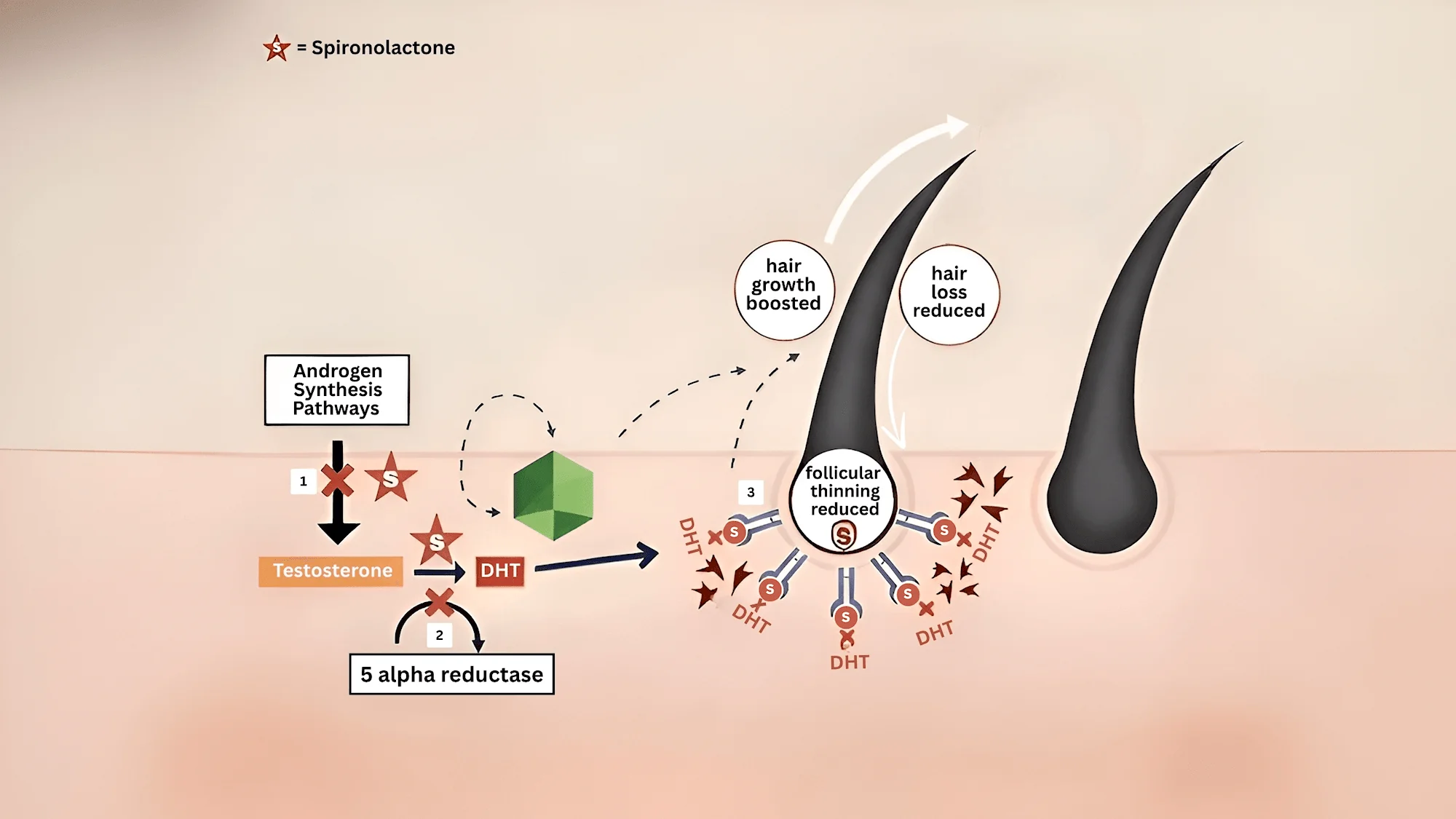
This is different from finasteride and dutasteride. These medications primarily reduce DHT by blocking the enzyme that converts testosterone into DHT, while spironolactone mainly works by blocking the effects of both testosterone and DHT at the androgen receptor.
A woman does not need to have a high testosterone level for spironolactone to potentially help. Hair follicles can be unusually sensitive to normal androgen levels.
Why Is Spironolactone Used for Female Pattern Hair Loss?
Spironolactone may be particularly useful when female pattern hair loss occurs along with other signs of androgen activity, such as:
- Hormonal acne
- Excess facial or body hair
- Oily skin
- Irregular menstrual cycles
- Polyendocrine Metabolic Ovarian Syndrome (PMOS), formerly called PCOS
What Dose of Oral Spironolactone Is Used for Hair Loss?
Published hair loss studies have used oral spironolactone doses ranging from about 25 mg to 200 mg daily. A systematic review found that most studied oral doses were approximately 80–110 mg daily.2
Earlier research used doses as high as 200 mg daily, while newer randomized studies have shown benefit with 80–100 mg daily, particularly when spironolactone is combined with minoxidil.3,4
Lower doses may also be useful for selected patients, especially when combined with minoxidil, but the evidence is less extensive at very low doses.5
Does a Higher Dose Work Better?
Not necessarily for every patient. Higher doses create stronger anti-androgen effects, but they can also increase side effects such as menstrual irregularities, dizziness, breast tenderness, and increased urination.
For many women, the better strategy is to use the lowest dose that provides a useful response while remaining comfortable and safe.
How Effective Is Oral Spironolactone for Female Pattern Hair Loss?
One long-term study followed 80 women with female pattern hair loss for at least 12 months. Forty women received oral spironolactone 200 mg daily, and 40 received cyproterone acetate. 44% of women showed hair regrowth, another 44% remained stable, and 12% continued to lose hair.3
This is important because successful treatment does not always mean dramatic regrowth. Preventing continued thinning can be a meaningful long-term result.
A 2023 systematic review and meta-analysis combined available studies of oral spironolactone for female pattern hair loss. Overall, 56.6% of patients were classified as improved. Improvement was approximately 43.2% when spironolactone was used alone and 65.8% when it was combined with other hair-loss treatments.6
Spironolactone and Minoxidil
Spironolactone and minoxidil work differently. Spironolactone reduces androgen signaling, while minoxidil directly supports hair growth. This is why they are often used together.7
A 2025 randomized, double-blind, placebo-controlled trial included 48 premenopausal women ages 21–45. All used topical minoxidil 3% twice daily; 24 also received oral spironolactone 100 mg daily and 24 received placebo. After 24 weeks, 38% of women taking spironolactone plus minoxidil had moderate-to-marked improvement, compared with 9% using minoxidil plus placebo.4
A pilot study followed 100 women taking a low-dose combination of oral minoxidil 0.25 mg and spironolactone 25 mg once daily. Over 12 months, the women experienced less hair shedding and an overall improvement in hair-loss severity.5
A 2022 randomized trial of 120 premenopausal women found that adding oral spironolactone 80–100 mg daily to topical minoxidil improved several hair measurements more than minoxidil alone, showing that spironolactone can provide additional benefit.7
Spironolactone vs. Finasteride and Dutasteride: Which Is Better for Women?
There is not enough high-quality research to say that spironolactone is less effective than finasteride or dutasteride for every woman.
A 2024 study found that women taking low-dose oral minoxidil with either spironolactone or finasteride/dutasteride improved. The finasteride/dutasteride group had greater average improvements in hair density and thickness, but the differences were not large enough to prove that these medications were more effective than spironolactone.8
Another randomized study of 60 women found that both topical minoxidil plus oral spironolactone and topical minoxidil plus oral finasteride improved hair loss.9
Does Spironolactone Cause Initial Hair Shedding?
Spironolactone is not well known for causing the early treatment shed sometimes seen with minoxidil. Some patients may notice changes in shedding after starting treatment, but no reliable clinical data show how often this occurs or how long it lasts.
Early shedding also does not automatically mean the medication is making hair loss worse. The underlying hair-loss process may still be active while treatment is beginning to take effect.
How Quickly Does Spironolactone Work?
Hair grows slowly, so spironolactone should be judged in months rather than weeks.
First 1–3 months:
It is usually too early to know how well treatment is working.
3–6 months:
Some women may begin to notice less shedding or slower progression.
6–12 months:
Changes in density, thickness, or overall stability become easier to evaluate.
12 months and beyond:
Some women continue to improve, while ongoing treatment can help maintain the hair being protected.
What Happens if You Stop Spironolactone?
A common misconception is that stopping spironolactone permanently makes hair loss worse. Spironolactone helps control androgen signaling, but it does not cure the underlying tendency toward female pattern hair loss. When treatment stops, its benefit gradually wears off and the hair-loss process can resume.
Think of it like medication used to manage another chronic condition: it helps control the problem while you take it, but continued treatment is generally needed to maintain the benefit.
What Are the Side Effects of Spironolactone?
Most women tolerate spironolactone well, but side effects can occur. No single percentage applies to every patient because risk changes with dose, age, kidney function, other medications, and the population being studied. The percentages below use hair-loss studies whenever possible.
- Increased urination
- Dizziness or headache
- Low blood pressure
- Fatigue
- Breast tenderness
- Menstrual irregularities or cramps
- High potassium
Menstrual Changes
Menstrual changes are among the more common side effects in premenopausal women. These can include spotting, irregular cycles, missed periods, or changes in menstrual flow.
In the 2025 randomized trial, menstrual irregularities occurred in 37.5% of women taking oral spironolactone 100 mg daily with topical minoxidil.4
For some women, hormonal contraception can reduce irregular bleeding while also providing pregnancy prevention, although whether it is appropriate depends on the individual patient.
Who Is More Likely to Need Potassium Monitoring?
- Women over 45, especially older adults
- Patients with kidney disease or reduced kidney function
- Patients who have previously had high potassium
- Patients with diabetes or other significant medical conditions
- Patients taking medications that can raise potassium
- Patients using potassium supplements or potassium-containing salt substitutes
Does Spironolactone Increase Cancer Risk?
A 2022 systematic review and meta-analysis included seven studies with more than 4.5 million people. Spironolactone was not associated with a statistically significant increase in breast cancer or the other types of cancer evaluated.11
A 2024 study compared 420 women taking spironolactone for acne, hair loss, or unwanted facial or body hair with 3,272 women who were not taking it. The median spironolactone dose was 100 mg daily. Researchers found no increased risk of breast or gynecologic tumors in women taking spironolactone.12
Spironolactone and Pregnancy
Spironolactone is generally avoided during pregnancy because it blocks androgen hormones, which are important for the normal development of a male baby’s genitalia. This creates a theoretical risk to a developing male fetus. Human pregnancy studies are limited, so we cannot say that spironolactone is safe to use during pregnancy.13
Women who could become pregnant should discuss pregnancy plans and reliable contraception with their prescribing physician. If pregnancy occurs while taking spironolactone, contact the prescribing physician.
What About Breastfeeding?
Only a very small amount of its active breakdown product, canrenone, passes into breast milk. In one study, the estimated amount reaching the infant was only about 0.2% of the mother’s dose.14
However, because hair loss treatment is not medically necessary during breastfeeding and long-term information in breastfed infants is limited, the decision to continue spironolactone should be discussed with the prescribing physician and the child’s clinician.
Can Men Take Spironolactone for Male Pattern Hair Loss?
Spironolactone can be prescribed to men for other medical conditions, but it is generally not used for male pattern hair loss because it blocks the effects of male hormones throughout the body. This can sometimes cause unwanted side effects such as breast tenderness or enlargement, lower sex drive, or erectile dysfunction.
For most men with male pattern hair loss, finasteride or dutasteride are usually better options because they specifically reduce DHT, the hormone primarily responsible for shrinking susceptible hair follicles.
Spironolactone and PMOS
Spironolactone is commonly used in women with Polyendocrine Metabolic Ovarian Syndrome (PMOS), formerly PCOS, when androgen-related symptoms are present.
Spironolactone does not treat every part of PMOS, but its anti-androgen effects can help reduce symptoms driven by androgen activity.15
Who May Be a Good Candidate for Spironolactone?
- Women with female pattern hair loss
- Women with hormonal acne or unwanted facial or body hair
- Women with PMOS and androgen-related symptoms
- Women who may benefit from combining an anti-androgen with minoxidil
Who Should Talk With Their Physician Before Starting Spironolactone?
- Patients with kidney disease or reduced kidney function
- Patients with high potassium
- Patients taking medications or supplements that raise potassium
- Patients with naturally low blood pressure or frequent dizziness
- Patients already taking a diuretic or several blood-pressure medications
- Older women who may have a greater risk of elevated potassium levels
- Women who are pregnant, planning pregnancy, or could become pregnant
Having one of these concerns does not automatically mean spironolactone cannot be used. It means the dose, risks, alternatives, and monitoring should be individualized.
Where Spironolactone Fits Into a Long-Term Hair Loss Plan
For some women, success means visibly thicker hair. For others, it means slowing progression and keeping the hair they already have. Sometimes the most important benefit is the hair that was preserved because treatment slowed a chronic process.
Because female pattern hair loss can be ongoing, hair may look better at some times and thinner at others. Illness, nutrition, hormones, scalp inflammation, aging, medications, bloodwork abnormalities, and other causes of shedding can overlap with genetic hair loss.
This is why we evaluate hair over time using photographs and scalp examinations, along with blood work, nutrition, and an overall health review when appropriate. The goal is to determine whether the hair is improving, remaining stable, or continuing to thin—and whether anything else needs to be addressed.
For patients who benefit from spironolactone, continued treatment is generally needed to maintain the results.