
What Is Telogen Effluvium?
Telogen effluvium is a common form of temporary hair shedding. It develops when more hair follicles than usual leave the active growth phase and enter the resting phase. Several weeks later, those hairs are released from the scalp.
The shedding can feel sudden and dramatic, but telogen effluvium does not destroy the hair follicles or cause scarring. In most cases, the follicles remain capable of growing new hair.1
Telogen effluvium can affect people of any age or sex. It often follows an illness, surgery, major emotional stress, hormonal change, rapid weight loss, nutritional deficiency, or medication change. Sometimes more than one trigger is involved, and occasionally no clear trigger can be identified.
Understanding the Hair Growth Cycle
Each scalp hair passes through a repeating cycle:
- Anagen is the active growth phase. Most scalp hairs are normally in this phase.
- Catagen is a brief transition phase during which growth stops.
- Telogen is the resting phase.
- Exogen is the stage when the resting hair is released and sheds.
With telogen effluvium, a trigger causes an unusually large number of follicles to enter the resting phase at approximately the same time. Because resting hairs remain in the scalp for a while before being released, the shedding usually does not begin immediately after the trigger. It most often becomes noticeable about two to three months later.2
What Telogen Effluvium Looks and Feels Like
The main symptom is increased shedding from across the scalp. You may notice:
- More hair than usual in the shower, sink, brush, bedding, or clothing
- Hair coming out during washing or styling
- A smaller ponytail
- Less overall volume
- More scalp showing through the hair
- Short regrowing hairs once recovery begins
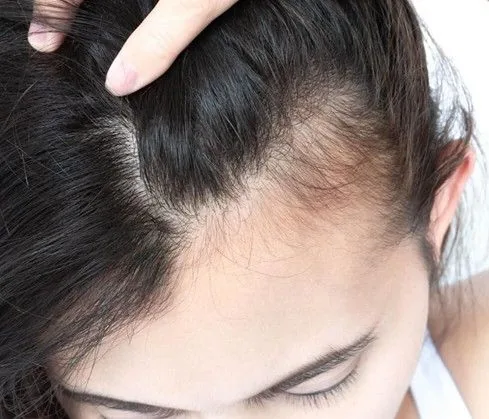
The thinning is usually diffuse, meaning it affects the scalp broadly rather than creating one completely bald patch. Some areas may appear more affected than others, especially if another type of hair loss is also present.
The number of hairs shed each day cannot diagnose telogen effluvium by itself. Shedding naturally varies according to washing frequency, styling practices, hair length, and how hairs are collected. What matters most is a clear change from your usual pattern, together with the timing, examination findings, and medical history.
Some people also report scalp tenderness, tingling, burning, or discomfort known as trichodynia. This symptom can accompany several forms of hair loss and does not prove scalp inflammation or permanent hair follicle damage.
The Usual Timeline
Acute telogen effluvium generally lasts less than six months. A typical course is:
- A trigger occurs.
- Increased shedding begins approximately two to three months later, although the timing can vary.
- Shedding continues for several weeks or months.
- The shedding gradually decreases after the trigger has passed or been treated.
- New hairs grow, but visible fullness returns slowly because scalp hair grows only about one centimeter (just under ½ inch) per month.
Many people begin to notice regrowth within several months. Restoring previous density may take six to twelve months or longer, particularly when the hair is long, the episode was severe, or another hair loss condition is present.
Chronic Telogen Effluvium
Shedding that continues for more than six months is generally classified as chronic telogen effluvium. It may fluctuate, with periods of heavier and lighter shedding, and can persist for years.
Chronic shedding does not automatically mean that the hair follicles are permanently deteriorating. However, the diagnosis should be reconsidered when shedding persists. Ongoing triggers and genetic pattern hair loss may produce a similar presentation or occur at the same time.2
Common Triggers
Illness, Fever, Surgery, and Physical Stress
A major illness, high fever, infection, hospitalization, surgery, significant blood loss, or physical trauma can disrupt the hair cycle. The person may feel fully recovered by the time the shedding begins, which can make the connection easy to miss.
COVID-19 and other significant infections can trigger telogen effluvium. Studies of post-COVID hair shedding have generally found onset within one to three months of infection, although illness severity, medications, weight changes, nutrition, and emotional stress may all contribute.3
Emotional Stress
Severe or prolonged emotional stress may contribute to telogen effluvium, but ordinary day-to-day stress does not explain every episode of shedding. Bereavement, major relationship or financial difficulties, traumatic events, and serious mental health challenges may be relevant triggers.
Hair loss can also create substantial emotional distress. This may produce a difficult cycle in which shedding increases anxiety and anxiety makes the shedding feel even more overwhelming. The psychological effect is real and deserves attention, even when the hair loss is expected to improve.4
Pregnancy and Postpartum Hair Shedding
During pregnancy, higher estrogen levels keep more hairs than usual in the growth phase, so many women notice that their hair feels thicker or fuller.
After delivery, estrogen levels return to normal. As a result, many of the hairs that stayed in the growth phase during pregnancy shift into the resting phase around the same time. Those hairs are then shed several weeks to months later.
Postpartum shedding usually improves without specific treatment, and most women regain much of their previous density within the first year. A prolonged or incomplete recovery should prompt evaluation for other contributors, such as iron deficiency, thyroid disease, nutritional deficiencies, or genetic female pattern hair loss.
Postpartum hair shedding does not mean that pregnancy permanently “used up” the hair follicles. It reflects a synchronized shift in the normal hair cycle.
Starting or Stopping Hormonal Contraception
Starting, stopping, or changing hormonal contraception can occasionally be followed by telogen effluvium. The relationship is not predictable, and most people do not develop significant shedding.
Hormonal contraceptives may also influence genetic female pattern hair loss in susceptible patients, depending on the person’s genetics and the hormonal properties of the medication. Telogen effluvium and genetic female pattern hair loss should therefore be evaluated separately rather than assuming that every change is temporary shedding.
Do not stop prescribed contraception solely because of hair loss without first discussing pregnancy prevention and alternative options with the prescribing physician.
Fertility Treatment
Hair shedding has been reported during or after fertility treatment, but research directly linking in vitro fertilization medications to telogen effluvium remains limited. Hormonal changes, emotional strain, procedures, illness, dietary changes, and pregnancy-related changes may overlap.
The timing and pattern of hair loss should be evaluated before attributing it to a specific fertility medication.
Thyroid Disease
Both an underactive thyroid (hypothyroidism) and an overactive thyroid (hyperthyroidism) can cause increased hair shedding.
Thyroid hormones help regulate many functions in the body, including the hair growth cycle. When thyroid hormone levels are too low or too high, the normal timing of that cycle can be disrupted. More hairs may leave the growth phase and enter the resting phase at the same time. Several weeks to months later, those hairs shed, which can cause diffuse thinning throughout the scalp.
Hair changes are more likely when thyroid disease is untreated or not well controlled. Once thyroid levels are properly managed, the hair cycle can gradually return toward normal.
A thyroid result within the laboratory reference range generally does not need treatment simply to reach a presumed “optimal” number for hair growth. Thyroid results should be interpreted along with symptoms, medical history, physical examination, and other appropriate testing. Taking unnecessary thyroid hormone can cause important health problems.
Hashimoto’s thyroiditis is an autoimmune thyroid condition. People with Hashimoto’s may also be more likely to develop alopecia areata, another autoimmune condition that typically causes smooth, round, or patchy areas of hair loss. Alopecia areata is different from the diffuse shedding of telogen effluvium and requires its own diagnosis and treatment.
Iron Deficiency and Other Nutritional Problems
Hair is not essential for survival, so when the body doesn’t get enough calories, protein, iron, or other important nutrients, it may redirect resources to more essential organs and functions. This can disturb the normal hair growth cycle and push more hairs into the resting phase. Those hairs may then shed several weeks to months later, causing telogen effluvium.
Common situations that can lead to this include:
- Heavy menstrual bleeding or other blood loss
- Pregnancy and childbirth
- Restrictive dieting or an eating disorder
- Rapid weight loss
- Not eating enough protein or calories
- Celiac disease, inflammatory bowel disease, or another condition that reduces nutrient absorption
- Weight loss surgery
- Frequent blood donation
Iron and ferritin: Iron is needed throughout the body for normal cell function and oxygen delivery. Hair follicles are very active tissues, so iron deficiency may interfere with normal hair growth. Ferritin is a blood test that helps show how much iron your body has stored. These iron stores can become low before anemia develops, so a normal hemoglobin level does not always mean your iron stores are adequate. In some people, low iron or low ferritin may contribute to diffuse hair shedding.
Other nutrients: Protein provides the building blocks used to make hair. Zinc, folate (vitamin B9), vitamin B12, and vitamin D also play roles in normal cell growth and hair follicle function. A significant deficiency may interfere with the hair cycle and contribute to shedding. However, a mildly abnormal level does not always mean it causes hair loss.
The goal is to identify and correct a true deficiency, not simply take more supplements. Extra vitamins generally do not make hair grow faster when your nutritional levels are already adequate. In fact, too much vitamin A or selenium can cause hair loss, and high-dose biotin can interfere with important blood tests.
Rapid Weight Loss and Bariatric Surgery
Significant weight loss can trigger shedding through several overlapping factors, including reduced calorie or protein intake, the physical stress of weight loss, surgery, blood loss, and nutrient deficiency.
Hair loss is common after metabolic and bariatric surgery. A systematic review found that it was more frequent in younger patients, women, and patients with lower ferritin, zinc, or folate levels, although these findings do not prove that supplementing every patient beyond standard postoperative recommendations will prevent shedding.5
Patients who have undergone bariatric surgery should follow the nutrition and laboratory-monitoring plan provided by their surgical team. Supplement needs vary according to the individual’s laboratory results.
Medications
A medication can sometimes trigger diffuse shedding, usually within several weeks to a few months of starting treatment or changing the dose. Reported medications include:
- Anticoagulants (blood thinners)
- Blood pressure-lowering medications (beta blockers) and other cardiovascular medications
- Antidepressants and mood stabilizers
- Retinoids, including isotretinoin
- Antiseizure medications
- Thyroid medications when the dose produces abnormal thyroid levels
- Hormonal therapies
- Certain cholesterol-lowering medications
This list does not prove that any individual medication caused the hair loss. Many reported associations are based on case reports or observational evidence, and illness itself may be the trigger.
Chemotherapy more commonly causes anagen effluvium, a different type of rapid hair loss that affects hairs while they are actively growing.
Never stop a prescribed medication abruptly because of shedding. The prescribing physician can review the timing, consider other causes, and determine whether continued treatment, dose adjustment, or an alternative medication is appropriate.
GLP-1 Medications
Hair loss has been reported by some patients taking medications such as semaglutide and tirzepatide. Current evidence suggests an association, but it has not been established that these medications directly damage hair follicles.
Rapid weight loss, reduced calorie or protein intake, nausea, dietary restriction, nutrient deficiencies, and preexisting hair loss may contribute. Recent systematic reviews have found that telogen effluvium is among the hair loss patterns reported with GLP-1-based medications, while emphasizing that better prospective studies are needed to determine cause and individual risk.6
Do not stop a GLP-1 medication without discussing the benefits, risks, rate of weight loss, and nutritional plan with the prescribing physician.
How Telogen Effluvium Is Diagnosed
There is no single blood test that diagnoses telogen effluvium. Diagnosis begins with the shedding pattern and timing.
A thorough evaluation may include:
- When the shedding began and how it has changed
- Illnesses, fever, surgery, childbirth, weight loss, and major stressors during the preceding several months
- Current and recently changed medications or supplements
- Diet, menstrual bleeding, pregnancy history, and gastrointestinal symptoms
- Personal and family history of hair loss
- Examination of the scalp, hair shafts, and overall pattern of density
- A hair-pull test when appropriate
- Bloodwork
A scalp biopsy is rarely needed. It may be helpful when the diagnosis remains uncertain, shedding is persistent, or the examination suggests another condition.
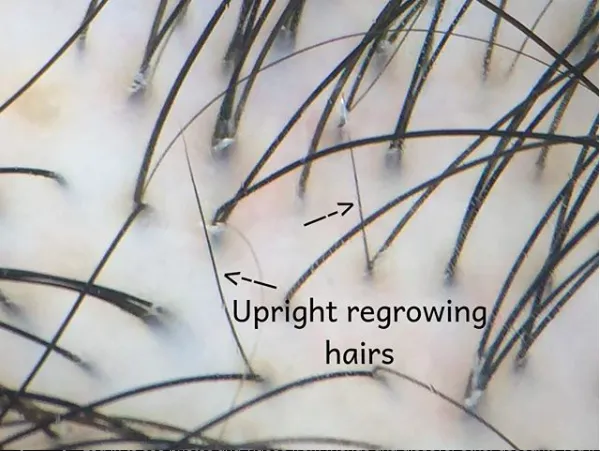
Trichoscopy shows visible dilated blood vessels (capillaries), several regrowing hairs, an increased number of follicular units with one terminal hair, empty follicles, and decreased hair density.

Telogen Effluvium Versus Genetic Pattern Hair Loss
Telogen effluvium and androgenetic alopecia, also called genetic female or male pattern hair loss, are different conditions, but they frequently overlap.
| Telogen Effluvium | Genetic Pattern Hair Loss |
|---|---|
| Usually begins with sudden, noticeable shedding | Usually develops as gradual thinning but can begin with shedding |
| Often follows a trigger | Strongly influenced by genetics |
| Typically affects the scalp diffusely | Commonly affects any part of the scalp in a recognizable pattern |
| Does not cause follicle miniaturization by itself | Causes follicles to produce progressively finer, shorter hairs |
| Often improves after the trigger resolves | Requires ongoing management |
Telogen effluvium can make existing genetic hair loss more noticeable. With genetic hair loss, some hairs gradually grow finer and shorter, but these changes may be difficult to see at first. A sudden increase in shedding can make that thinning more visible. This does not necessarily mean telogen effluvium started the genetic hair loss. It may simply have revealed genetic hair loss changes that were already happening.
Other Conditions That Can Resemble Telogen Effluvium
Diffuse shedding should not automatically be labeled telogen effluvium. Other possibilities include:
- Genetic female or male pattern hair loss
- Diffuse alopecia areata
- Early scarring alopecia
- Anagen effluvium
- Hair breakage caused by chemical processing, heat, or mechanical damage
- Traction alopecia from repeated tension
- Inflammatory scalp conditions
Seborrheic dermatitis and psoriasis can make the scalp itchy, inflamed, and scaly. Scratching, rubbing, and picking at the scalp can increase hair breakage and make shedding seem worse.
Treating Telogen Effluvium
Identify and Address the Trigger
The most important treatment is to identify and correct any ongoing cause when possible. This may involve:
- Allowing your body time to recover after a significant illness, surgery, or hospitalization. Hair shedding may continue for a while even after you feel better because the hair growth cycle takes time to recover.2
- Treating iron deficiency, thyroid disease, or another medical condition
- Restoring adequate calorie and protein intake
- Correcting a confirmed nutritional deficiency
- Slowing an overly rapid rate of weight loss when medically appropriate
- Reviewing medications with the prescribing clinician
- Treating an eating disorder or gastrointestinal condition
- Addressing severe or persistent emotional stress
Shedding may continue for a while after the trigger has resolved because hairs that already entered the resting phase still need to complete that part of the cycle. Continued shedding during this delay does not necessarily mean that treatment has failed.
Minoxidil
Acute telogen effluvium often improves without medication. Topical minoxidil is sometimes used off-label when shedding is prolonged, regrowth is slow, or genetic pattern hair loss is also present.
Low-dose oral minoxidil is also used off-label in selected patients. A retrospective study of 36 women with chronic telogen effluvium reported lower shedding scores during treatment, but controlled trials are still needed.7
Platelet Rich Plasma and Low-Level Light Therapy
Platelet rich plasma and low-level light devices have been studied more extensively for genetic pattern hair loss than for telogen effluvium. Evidence that either treatment changes the natural course of isolated telogen effluvium is currently limited.
These options may be considered when genetic pattern hair loss is also present, but they should not replace evaluation and correction of an underlying medical, nutritional, or medication-related trigger.
Hair and Scalp Care During Recovery
Gentle hair care can’t stop telogen effluvium, but it can reduce breakage and make recovery easier.
- Wash the scalp as often as needed for cleanliness and comfort. Shampooing releases hairs that were already ready to shed; it does not cause telogen effluvium.
- Use conditioner and detangle gently, especially when the hair is wet.
- Limit tight hairstyles that repeatedly pull on the follicles.
- Reduce excessive heat, bleaching, chemical straightening, and other practices that increase breakage.
- Treat persistent itching, scaling, or scalp inflammation appropriately.
- Use standardized photographs with similar lighting, hairstyle, angle, and part placement to monitor change over time.
Common Telogen Effluvium Myths
Myth: The White Bulb on a Shed Hair Is the Follicle
The small white club at the end of a shed telogen hair is keratinized material. It is not the living follicle. The follicle remains beneath the skin and can produce another hair.
Myth: Washing Makes Telogen Effluvium Worse
Washing removes hairs that are already ready to shed. Delaying shampooing may make the next wash look more alarming because several days of shed hairs are released at once.
Myth: Every Episode of Heavy Shedding Causes Permanent Baldness
Telogen effluvium is nonscarring and often reversible. Lasting or progressive thinning raises the possibility of an ongoing trigger, genetic pattern hair loss, or another condition that requires separate evaluation.
Myth: A Hair Vitamin Will Treat Any Type of Shedding
Supplements help when they correct a genuine deficiency or meet a specific nutritional need. They do not substitute for an accurate diagnosis and treatment, and taking excessive amounts of certain nutrients can worsen hair loss or create other health problems.